

Disclosure: A copy of A Systematic Theology of Love was provided to me by the author and/or the publisher. No expectation of a review or specific comments therein accompanied that gift.
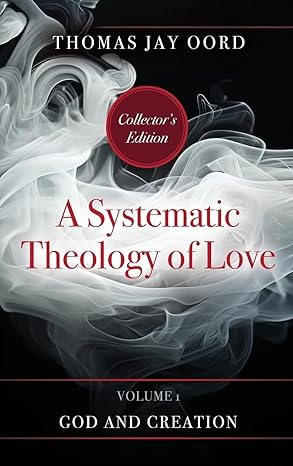
The theology of Thomas Jay Oord has intrigued me since I encountered The Uncontrolling Love of God. I appreciate his desire for logical consistency, his engagement with science, and his reluctance to appeal to mystery if other options are available. His approach to the problem of evil makes more sense to me than any other I’ve come across. But of course none of that matters if his ideas aren’t seriously engaged with scripture. Fortunately, they are; everything stems from an understanding of God centered on love as reported throughout the testimony of Biblical writers. That orientation has led now to A Systematic Theology of Love, the first volume of which focuses on God and Creation. I won’t be unpacking the whole thing–although I think it is all worthwhile to consider–but focusing mainly on the places where it connects to science. We’ll look at the model of creation, panpsychism, and the problem of good.
Let’s start with the problem of good, since my comment is minor. Oord has a lot to say about the problem of evil–why does evil exist if God is good–throughout the book, since it is frequently cited as a significant barrier to faith. In the final chapter, he takes up the complementary problem of good, which asks whether the world could be as good and beautiful as it is without God. I’m personally not convinced there’s a perfect symmetry there; I think the problem of evil carries more force. Still, it’s a reasonable issue to address when being comprehensive.
To establish that there is such a problem, Oord first needs to establish that there aren’t other explanations. When it comes to the good done by living things, evolution is an obvious one. He does cite several works on the evolution of altruism, and summarizes them as claiming that “creatures are ultimately selfish, because every creature acts only for its own reproductive success” (p 390). Some may make such claims, but I don’t think that’s a broad consensus. For instance, I don’t think Martin Nowak comes to such a conclusion in SuperCooperators, since his mechanism for the evolution of altruism involves group selection. Further, we observe behaviors that are not just for the actor’s own reproductive success, such as treating the wounds of others. Thus it is not so clear to me that evolution can be dismissed as an explanation for good done by creatures. At the same time, Oord’s model of creation is not at odds with evolution, so evolving altruism can still be attributed to God. I’m not sure to disentangle those elements to settle the problem of good, which is a big part of why I don’t think it is as compelling as the problem of evil.
As for that model of creation, Oord rejects creatio ex nihilo and proposes instead creatio ex creatione sempiternalis en amore, which he translates as “God everlastingly creates out of creation in love” (p 292). I think Oord makes a strong case that creatio ex nihilo is not a necessary conclusion from scripture. And rejecting creatio ex nihilo aligns well with Oord’s theology of love, in which God cannot coerce or unilaterally bring anything about by fiat. I’m open to all of that, At the same time, I struggle to understanding exactly how Oord’s model works. He simultaneously embraces the idea of God everlastingly creating entities, each of which have finite spans in time and space. Yet he rejects the idea of any kind of actual infinite as incoherent. If the point is that the number of things cannot be “infinity,” fair enough; infinity is not a number that can be reached like 42. But infinity is also the shorthand we use in math for a series that goes on everlastingly. So I’m not sure that everlasting creation can be entirely separated from the notion of the infinite.
I’m also having trouble wrapping my head around how there is always something distinct from and yet dependent on God for God to create with. On some level, I know that when dealing with the everlasting, the question of where did the first “stuff” come from will be met with “there was no first.” Still, it is a hard question to let go of, because an answer would help me know how to better understand the relationship between the dependency of creation on God while maintaining the God is not a sufficient cause. In fairness, it’s not as if we have physics models that definitively answer these kinds of questions either. So for now, perhaps we just have to live with not knowing all the details.
Another aspect of Oord’s model is to ascribe agency to entities at all scales of creation. I can see where that aligns with the idea that God coaxes rather than coerces. How do you coax a quark if it has no agency? This also comes with a form of panpsychism, ascribing a mental aspect to all of those entities as well. Again, this seems like a natural extension; we tend to associate agency with minds. I don’t believe Oord explicitly ties all of these elements together in this way, but they do seem to fit together well. However, I’ve always struggled with panpsychism, so I wonder if there isn’t another way.
Arguably, Oord has an issue with panpsychism as well. He finds it easy to describe subatomic particles as having agency and thus a mental aspect, and of course many accept that various living organisms have agency to one degree or another. But he feels obligated to come up with a story about the mental aspect of rocks and chairs. I don’t think it’s an accident that everything which poses a challenge falls into the category of “inanimate object.” I actually think his explanation for why rocks don’t appear to think is largely correct. He says that they are not organized in a way that allows the small mentality of each component particle to add together, like metal which is not a magnet because the dipoles of its components are scrambled rather than aligned. I agree that minds require a particular type of organization not found in rocks or rockers. That organization includes sufficient internal degrees of freedom to facilitate information processing. For this reason, I also don’t think quarks can have a mental aspect, because they have no internal degrees of freedom.
The other reason I find it difficult to ascribe a mental aspect to quarks is because the ontology at that level isn’t quite so neat. Our current best understanding is that what is fundamental are various universal fields, and what we register as particles are localized excitations of those fields. So is it the quark field, for example, that has a mental aspect, or each individual excitation? If the latter, does the mental aspect come and go as virtual particles emerge and return to the vacuum state? Maybe these are again the wrong questions, but they are what come to mind when I contemplate panpsychism.
When I thought about the problem of good, another issue that came to mind is Herbert Spencer’s notion that whatever persists, exists. Oord defines goodness and evil in terms of making the world overall better or worse, respectively. It seems to me that things which make the world better will have a greater tendency to persist and proliferate, while things that make the world worse won’t. This creates a selective filter towards the good. This could be part of an answer to the problem of good. But let’s take that a step further. Perhaps the space of possibilities is constructed in such a way that it is biased towards the good. And what if we suppose that God is the reason it is constructed this way.
I think this has a few advantages. One, it allows us to describe how God could coax entities which do not have a mental aspect or agency; God arranges the possibilities for them to tend in a particular way. This is not the same as determinism; it is a stochastic bias which still allows complete moment-to-moment freedom. Two, it potentially offers dimensions for the divine Spirit to have a substance, rather than in the dimensions of the physical dimensions where our substance is realized. And three, it addresses the problem of good in scientific language without excluding God; it gets into some of how God does what God does rather than describing an alternative.
Allow me to be the first to admit these are just some inklings, not nearly as robustly interrogated as Oord’s systematic theology. His answers may also be more correct in addition to being more comprehensive. But what I appreciate about A Systematic Theology of Love, in addition to all the things I think it describes well and correctly which I have at best hinted at, is that it is different enough from other theologies I’ve engaged with that it can inspire new questions and new inklings. I hope it can do the same for you.

Andy has worn many hats in his life. He knows this is a dreadfully clichéd notion, but since it is also literally true he uses it anyway. Among his current metaphorical hats: husband of one wife, father of two teenagers, reader of science fiction and science fact, enthusiast of contemporary symphonic music, and chief science officer. Previous metaphorical hats include: comp bio postdoc, molecular biology grad student, InterVarsity chapter president (that one came with a literal hat), music store clerk, house painter, and mosquito trapper. Among his more unique literal hats: British bobby, captain’s hats (of varying levels of authenticity) of several specific vessels, a deerstalker from 221B Baker St, and a railroad engineer’s cap. His monthly Science in Review is drawn from his weekly Science Corner posts — Wednesdays, 8am (Eastern) on the Emerging Scholars Network Blog. His book Faith across the Multiverse is available from Hendrickson.
Leave a Reply