We’re entering spooky season. I’ve always been of two minds about Halloween: I love the communal experience of trick-or-treating, but I’m not big on all the horror and gore and occult. I’m happy to see neighbors getting out and about, practicing generosities big and small, and celebrating the opportunity for kids to experiment with expressing different sides of themselves. And enjoying some leftover chocolate-y or peanut-butter-y treats is hardly a hardship. I’d just rather do all that without the bloody corpses, serial killers and demonic figures festooning quite so many lawns. Still, I’m trying to better appreciate the value some see in peering into these darker corners of our minds and experiences. Sometimes we need to simulate the darkness a bit to better appreciate the light.
So, in the spirit of the season, permit me to indulge one of the darker thoughts to which I find myself returning: namely, that these measles outbreaks are just the beginning. You see, I studied infectious diseases in graduate school. One of the lessons that made a strong impression described the relationship between herd immunity and R0. I’ll elaborate, but the key point is that measles is highly contagious measles and thus necessitates widespread resistance to achieve herd immunity. Consequently, as vaccination rates decline, measles is the first of the vaccine-preventable infections we expect to start breaking out and spreading.
I went into a fair amount of detail on herd immunity and R0 previously; I’ll try to summarize here. The simplest mathematical model we have for the spread of infectious diseases is a set of differential equations called the SIR model. SIR stands for Susceptible, Infected/Infectious, and Recovered/Resistant. Everyone in a population is in one of those states at a given time, and the equations describe the rates at which people transition between them. R0 is a number from the model that reflects how many people can be infected by a single infectious person when everyone is susceptible; thus a more contagious pathogen will have a higher R0.
The pattern described by the SIR model is one where infection spreads faster and faster as each infected individual infects more than one susceptible person. At a critical point, that ratio flips to less than one, and subsequently infections dwindle. This is because more and more people have become resistant, making it less and less likely for an infected person to interact with enough susceptible people to infect more than one. Eventually, the infection might stop spreading altogether even though there are still susceptible people. And therein lies the basis for herd immunity, the idea that some people in a population never get infected not because of their own personal immune resistance but because of the collective resistance of their community. When in the process that flip from more than one to less than one occurs depends on R0; the more contagious a pathogen is, the more resistance it takes.
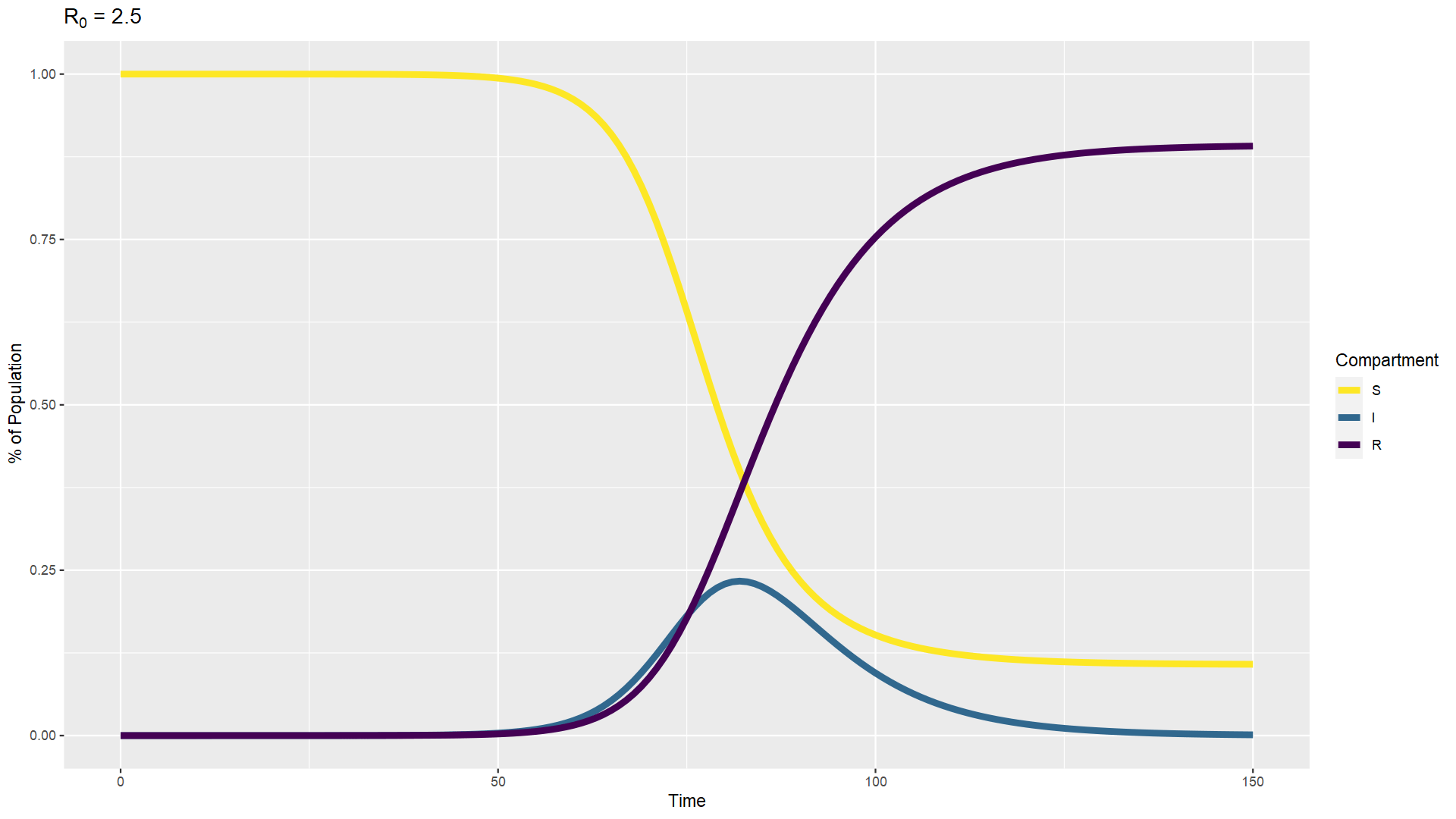
The SIR model makes a lot of simplifying assumptions to highlight fundamental patterns. It also provides a framework which can be further complicated to get closer and closer to realistic scenarios. One straightforward complication is to allow that people can be resistant from vaccination rather than infection. We can then work out what level of vaccination is required for community resistance. For measles this works out to percentages in the mid 90s. This is at the high end for known pathogens, because measles is at the high end of known R0 values–usually estimated from 12-18. For comparison, SARS-CoV-2 had an estimated value of 2-3 early in the pandemic and Omicron variants have estimated values starting around 10. (Despite this increase, there is less illness now because of widespread immunity following vaccrecovery from infection and/or vaccination.) Pertussis (or whooping cough) is slightly less contagious than measles (12-17), and chicken pox and mumps come in a little lower (10-12). Rubella, the third component of the MMR vaccine with measles and mumps, is the least contagious (6-7).
So if more people don’t get just the MMR vaccine, we’d expect measles cases to increase first, then mumps, and then rubella. If other vaccinations are also avoided more often, infections like pertussis will also spread. These are not guarantees of course. The pathogens also need to be introduced, which could impact timing and sequence. The point is that we have theory and empirical data which can inform what to expect, and can explain why measles is generally the first to spread when vaccination rates drop.
That’s also before we account for a curious unique feature of the measles virus: it can infect the memory cells of your immune system and thus reduce learned immunity to other infections. While measles cases are still relatively rare this may not have a noticeable effect at the population level, especially if infected folks tend to avoid many vaccinations, not just MMR. But if measles spreads more widely, we might see cascading consequences for other diseases.
And if we may step a little further into the darkness, changes in vaccination rates are not the only infectious disease concern. Recent years are among the warmest recorded. Mosquitoes thrive in warm weather, and warming conditions are allowing mosquitoes to thrive in new regions of space and time which were previously inhospitable. This creates more opportunities for mosquito-borne infections to spread. For example, this year saw a new contemporary high for locally spread dengue infections in the continental United States. We also have the mosquitoes that spread malaria and yellow fever here, and both diseases used to spread locally here also. Public health vigilance, not any limitation of biology, climate or habitat, is all that keeps those infections and others from becoming endemic in the US once again.
So where’s the light? Well, the good news is that none of these scenarios is “baked in”. We can make extrapolations based on models and past experience, but our choices can have a significant impact on actual outcomes. Just because vaccination rates are low enough today that community resistant to some infections is not present doesn’t mean they have to be that low tomorrow. Sure, distribution cannot be perfectly instantaneous. And a few words on a blog aren’t going to immediately assuage everyone’s concerns about vaccines. But those are practical matters which can be addressed, not insurmountable impossibilities. The point is that we can make informed predictions about where current trends are likely to lead, and also about what changes we can make to divert those trends. Hopefully that’s the right kind of spooky to be motivating rather than paralyzing.
Election day will follow close on the heels of Halloween. This cycle, we are once again seeing a disproportionate focus on policies around trans individuals. So it seems appropriate to add a reminder about just how out of proportion things have gotten and what the consequences can be.

Andy has worn many hats in his life. He knows this is a dreadfully clichéd notion, but since it is also literally true he uses it anyway. Among his current metaphorical hats: husband of one wife, father of two teenagers, reader of science fiction and science fact, enthusiast of contemporary symphonic music, and chief science officer. Previous metaphorical hats include: comp bio postdoc, molecular biology grad student, InterVarsity chapter president (that one came with a literal hat), music store clerk, house painter, and mosquito trapper. Among his more unique literal hats: British bobby, captain’s hats (of varying levels of authenticity) of several specific vessels, a deerstalker from 221B Baker St, and a railroad engineer’s cap. His monthly Science in Review is drawn from his weekly Science Corner posts — Wednesdays, 8am (Eastern) on the Emerging Scholars Network Blog. His book Faith across the Multiverse is available from Hendrickson.
Leave a Reply