

After several days at work prodding myself to complete, well let’s call it a non-preferred task, and given everything else going on in the world, I was struggling to find a science news story I wanted to write about. An astronomical anomaly? Pretty pictures, as always, but the possible explanations didn’t really stir the imagination. Commenting on the latest pronouncements from Health & Human Services? I can only go that well so many times (but please talk to your physician before making medical decisions or diet changes). DNA from da Vinci? A clever approach, but still far from conclusively identified, and even if it is, I’m not sure what we’ll learn. Gut microbiome getting you drunk? The last thing the world needs is another middle-aged white guy talking about homebrewing. But wait, what’s this? A study on how to manipulate neural pathways that leave monkeys unmotivated to perform a non-preferred task? Well, I suppose I must.
We’re two weeks into the new year, so maybe some of you are still extra motivated to follow through on your resolutions and goals. At the same time, maybe some of you had a rough holiday season for one reason or another and aren’t terribly enthusiastic about the possibilities offered by a fresh calendar page. Others may find yourselves hitting a wall in coming weeks thanks to cold temperatures, less daylight, and a muted color palette outside the window. And then there are the mental health diagnoses that can come with symptoms that inhibit motivation. All of that to say, whether it is now or in the future, you likely could use a motivation boost. So where did the monkeys get it from?
Would you believe a glow-in-the-dark virus infection and a designer drug injection to the brain? In other words, not a therapy coming to your local analysis couch or neighborhood pharmacy. These are research tools to facilitate the manipulation of specific nerves and neural pathways to understand their causal roles. But from that information might someday come interventions suitable for humans.
The virus infection is an adenovirus vector engineered to deliver specific genes to cells. This one delivered two: green fluorescent protein, so that successful and targeted infection could be confirmed under a microscope, and a protein receptor that uniquely binds a designer drug not normally found in monkey brains. Both genes are connected to a promoter so that their expression will occur in the cells of interest, in this case medium spiny neurons. The virus was injected to the ventral striatum (VS) to make sure it only infected neurons there. After that process, as long as Jung-min et al. did nothing else, the monkeys’ brains should go about their business as usual. But when they injected the designer drug (deschloroclozapine) to the ventral pallidum (VP), it would bind to the receptors in the infected VP nerves and inhibit them from firing and activating the VP nerves they connect to.
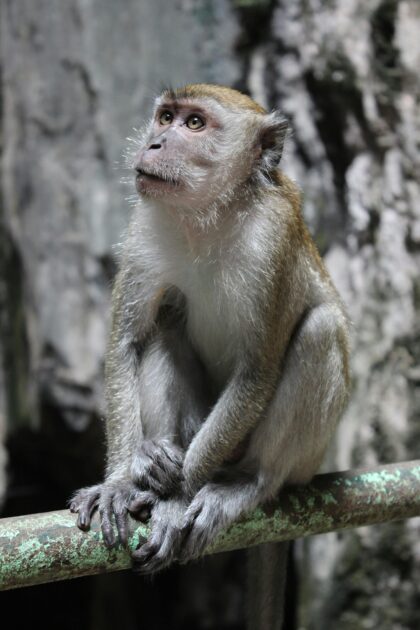
And how do you know when monkeys are motivated? The monkeys were trained on two tasks. In the first, they were offered a reward (some water) and if they accepted, they received the reward–easy peasy. In the second task, if they accepted, they received the reward and a puff of air to the face. As you might imagine, the puff of air was demotivating, as measured by how often they accepted the reward in the two different tasks, and how long they took to decide. Administering the designer drug, thus inhibiting the VS neurons so they did not activate the VP neurons, resulted in behavior on the second task closer to the behavior on the first task. This suggests that the firing of the VS neurons under normal circumstances works to suppress motivation.
In other words, the spirit is willing, but the VS-VP pathway is active. In the Bible, the psalmists, the prophets, the author of Ecclesiastes, Paul, and even Jesus struggle with knowing there is something they should do but being reluctant to do it–lest they experience consequences far worse than air in the face. In many of those cases, they eventually muster the resolve to proceed anyway. Was this divine intervention in their neural pathways, a supernatural equivalent of glowy-virus-plus-designer-drug? Obviously I can’t really know one way or the other with any confidence. Maybe God works that way, maybe God has other, less biochemical means, or maybe they changed their mind via more terrestrial means.
Even in monkeys, the effect of motivation and the VS-VP pathway is not all-or-nothing. Sometimes they were motivated despite the unpleasantness without intervention, sometimes they were unmotivated when there was only reward, and so on. And as far as we can tell, humans have additional capacities to reflect on our motivations that other animals do not, giving us further kinds of control over our behaviors. Neurons undoubtedly play a role in how we behave and why, but pointing to a single nerve or pathway and saying “That one made me do it” oversimplifies the interconnectedness of numerous pathways and how they respond to various inputs, external and internal, conscious and unconscious, physical and symbolic, past and present.
Even the paper indicates there is more to motivation than the VS-VP pathway. One of the things the researchers had to be careful of was that the results were not caused by changes in the value the monkeys’ assigned to the reward. That is a well-known way to impact motivation; there were plenty of tasks Scooby-Doo would turn down for one Scooby Snack but could be persuaded to do for two or three. The researchers wanted to exclude that explanation to study other aspects of the neuroscience, but in everyday life, all the pathways are on the table. I was genuinely ambivalent about this post until the right paper came along (in other words, presumably one I attached sufficient value to).
In the Bible, one of the rewards for getting past reluctance and disincentives is refinement of character and building of virtues. It would be interesting to see if there are ways to follow up on this VS-VP pathway to see what kinds of changes are associated with achieving hard goals or enduring difficult circumstances. On that front, my wife happens to be reading Grit which might be a handy resource if you having issues of motivation on the mind.

Andy has worn many hats in his life. He knows this is a dreadfully clichéd notion, but since it is also literally true he uses it anyway. Among his current metaphorical hats: husband of one wife, father of two teenagers, reader of science fiction and science fact, enthusiast of contemporary symphonic music, and chief science officer. Previous metaphorical hats include: comp bio postdoc, molecular biology grad student, InterVarsity chapter president (that one came with a literal hat), music store clerk, house painter, and mosquito trapper. Among his more unique literal hats: British bobby, captain’s hats (of varying levels of authenticity) of several specific vessels, a deerstalker from 221B Baker St, and a railroad engineer’s cap. His monthly Science in Review is drawn from his weekly Science Corner posts — Wednesdays, 8am (Eastern) on the Emerging Scholars Network Blog. His book Faith across the Multiverse is available from Hendrickson.
Leave a Reply