
-extract.jpg)
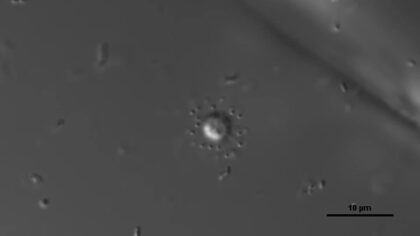
‘Tis the season to rehearse the arrival of a small, unexpected gift. So let’s talk about the latest microbe discovery: Solarion arienae. S. arienae is a single-celled eukaryote that was found living in sediment of the Adriatic Sea off the coast of Croatia. It is so named by Valt et al because it has a form which is reminiscent of the sun, a round central body with many protrusions in every direction that it uses for catching bacteria to eat. It turns out to be a distant relative of, well, nearly every other living organism. And it has mitochondria with distinctive features. Those qualities make it potentially very helpful in understanding just how we came to be here.
By way of reminder, the most basic distinction of all living creatures is between prokaryotes and eukaryotes. Bacteria are prokaryotes, so named because inside their cells they do not have distinct, membrane-bound compartment for their DNA. We and everything else alive & big enough to see are eukaryotes; we have a nucleus within our cells that keeps our DNA separate. Prokaryotes were here first, with eukaryotes first arriving at least 1.65 billion years ago and possibly 2.1 billion years ago or even earlier. They would have started as single cells like prokaryotes; multicellular beings came later. Piecing together the exact timing and the nature of the early eukaryotes is challenging for several reasons. One is that single cells don’t leave fossils the way dinosaurs do; there are some traces, but many crucial details are missing.
Another challenge for reconstructing the history of eukaryotes is that a lot can happen in ~2 billion years, specifically a lot of mutation. In the present era of cheap sequencing, we use DNA to answer many questions about past life using techniques collectively known as phylogenetics. We can be festive and think about phylogenetics in terms of Christmas gifts. Suppose you had three friends who went out Christmas shopping together. Later, when they give you the gifts they bought, one of them has gotten you gold, another got you gold and frankincense, and the third got you gold, frankincense and myrrh. What might you guess about their shopping trip?
To simplify the answer a bit, let’s assume you know that the each friend spent the same amount, e.g. the first friend brought you more gold than the other two, so we can rule out explanations based on differences in available funds. One simple explanation is that they started out together and all bought gold at the first store, then the first friend split off and the other two went to a frankincense store, and then the third friend went alone to the myrrh store. Of course, this isn’t a perfect analogy, and there are other possible explanations that work for shopping but not so well for biology. But hopefully you get the basic idea that the shopping pattern of starting together and then gradually splitting up leaves evidence in the pattern of gifts at the end.

Something similar happens with DNA. If you start with a single population that then splits into two, those two populations will have a lot of DNA in common but they will also start to accumulate different mutations. And if one of those two populations splits again, that pattern will repeat, and so on and so forth. Phylogenetics is the set of tools we use to work out which groups split off in what order, based on the patterns in the DNA. But if enough time has passed, those patterns can be harder and harder to find. In our shopping scenario, imagine our shoppers staying at the mall long enough after they split up that they all changed their mind, returned their initial purchases, and bought new gifts. Likewise, when populations have been split long enough, they get mutations in just about every spot possible, and some spots will go through multiple rounds, occasionally even going back to whatever was in that position in the first place (like a frankincense buyer exchanging that for gold). The longer this goes on, the harder it is to piece together the history.
What can potentially help in those cases is to find a new organism with distinctive features that can help fill in some missing pieces. Not all parts of DNA genomes can change at the same rate; some of it is fundamental and can only change very slowly if at all, while other parts are very flexible, and there’s a whole range in between. Using different parts can tell us about different periods of ancestry. The fast-changing parts can tell us about the relationships of very close relatives, while the slow-changing parts can tell us about distant relatives. But at best, you can only go as far back as the last common ancestor; beyond that, the slow-changing parts are all too similar and the fast-changing parts are all too different. So when something like S. arienae comes along that is different in different places, so to speak, it gives us the ability to resolve a new part of the puzzle.
I opened with a glib reference to Advent, but even I don’t actually want to stretch a metaphor that far. While I would consider this discovery something of a gift to science, probably a more apt religious analogy would be to the discovery of the Dead Sea Scrolls. The situation is not exactly the same; the discovered S. arienae individuals have not been preserved for billions of years. But they did diverge from most of the rest of the eukaryotes we know a very long time ago, and so they provide information about that past. And the exact same techniques we use to puzzle out that information are applied to manuscripts like the Dead Sea Scrolls to work out what the original documents would likely have said given the variations in current manuscripts. In both cases, any new variants that can shed light on what was previously dim is something to be grateful for.

Andy has worn many hats in his life. He knows this is a dreadfully clichéd notion, but since it is also literally true he uses it anyway. Among his current metaphorical hats: husband of one wife, father of two teenagers, reader of science fiction and science fact, enthusiast of contemporary symphonic music, and chief science officer. Previous metaphorical hats include: comp bio postdoc, molecular biology grad student, InterVarsity chapter president (that one came with a literal hat), music store clerk, house painter, and mosquito trapper. Among his more unique literal hats: British bobby, captain’s hats (of varying levels of authenticity) of several specific vessels, a deerstalker from 221B Baker St, and a railroad engineer’s cap. His monthly Science in Review is drawn from his weekly Science Corner posts — Wednesdays, 8am (Eastern) on the Emerging Scholars Network Blog. His book Faith across the Multiverse is available from Hendrickson.
Leave a Reply