Archive for the ‘christian smith’ tag
Emerging Adults’ View of Education
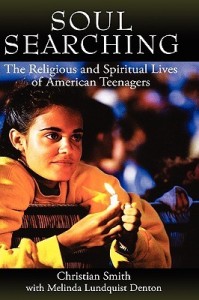
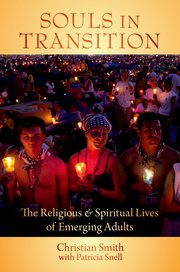
I’ve just begun reading Christian Smith’s new book (with Patricia Snell), Souls in Transition: The Religious & Spiritual Lives of Emerging Adults, and it’s already proving to be a useful resource. This is the follow-up to Smith’s last book (with Melina Denton), Soul Searching, which examined the religious lives of teenagers (ages 13 to 17). Technically, the term “emerging adults” applies to ages 18 to 29, but Souls in Transition only looks at ages 18 to 23. The rest of the “emerging adults” spectrum will be the focus of a planned third book. For an overview of Smith’s findings, check out this recent Christianity Today interview with Smith.
To set the stage for discussing religion and spirituality, Chapter 2 examines “The Cultural Worlds of Emerging Adults” – sex, relationships, morality, and so on. There’s lots of interesting stuff in this chapter – for example, Smith makes the case that emerging adults seem to be living out simplified versions of the philosophies of Jacques Derrida, Stanley Fish, Richard Rorty, and G. E. Moore – but today I’m going to highlight emerging adults’ views of education. As you might imagine, with so many either in college or aspiring to college, education forms an important part of their world view, but their view of education leans strongly to the pragmatic, instrumental value.
Many, though not all, emerging adults believe in the importance of finishing high school and getting a college education. Large numbers want to go to university, do well in school, get a degree, and put it to use. But for most, the motivating reasons behind their valuing higher education seem to have almost entirely to do with the instrumental advantages it produces — as well as the fun one can have while in college. What matters is getting the credits, earning the diploma, and becoming certified as a college-educated persona so that one can get a better job, earn more money, and become a good salary earner and supporter of a (materially) comfortable and secure life. Not very many emerging adults talk about the intrinsic value of an education, of the personal broadening and deepening of one’s understanding and appreciation of life and the world that expansive learning affords. Few talk about the value of a broad education for shaping people into informed and responsible citizens in civic life, for producing leaders and members who can work together toward the common good of all in society…For most, higher education is good instead because — besides the fun one can have while in college — it promises to help secure for individuals more rewarding jobs, higher income, and so greater personal prospects of materials and psychological well-being and security. (Smith, 54)
This attitude is not necessarily new (“Plastics,” anyone?), but elsewhere in this chapter Smith writes of emerging adults’ cultural relativism, desire for material comfort, lack of political or community engagement, and low expectations for changing the world. ESN’s mission is to see Christian scholars become redeeming influences, and InterVarsity’s Vision seeks “world changers developed,” so we are fighting against the current of the culture, according to Smith’s analysis. Since ESN encourages Christian students to pursue academic vocations, this attitude toward higher education can be a challenge to work against; important fields like the humanities can be, well, materially challenging.
Do you agree with Smith? Do emerging adults, ages 18-23, see higher education as primarily a path to middle class security? Have you seen exceptions to this? And, maybe most importantly, do Christian students mirror the culture, or are they a “counterculture for the common good”?
Week in Review: Milliennials in Transition Edition
Our Week-in-Review feature has a new format. We know there’s way too much to read out there already, so we’re going to be highlighting the top five articles, books, websites, etc., that we’ve been reading or thinking about the past week. If you have items you’d like us to consider for the top five, add them in the comments or send them to Tom or Mike.
The Millennial Muddle (Eric Hoover, Chronicle of Higher Education, October 11, 2009) takes awhile to wade through but is worth it. Tom’s placing this topic on his to post about list ;-) Anyone with research, reflections, or personal testimonies regarding how to understand/categorize/define/relate to (?) the Millennials?
Speaking of Speaking (Chronicle of Higher Education, October 15, 2009) by a Female Science Professor gives tips on public speaking, in particular how the type of introduction can have a significant effect, at least at the beginning of my talk, on my mood and presentation strategy. She gives several illustrations which you might find of benefit. Any illustrations of best/worst speaker introductions you’ve heard?
Tweed: Oh, You Lucky College Professors! Adjuncts, Too (Chronicle of Higher Education, October 14, 2009). Do you agree with …
Memo to America’s college professors: You have the third best job in the country.
This is according to a list of “the top 50 careers with great pay and growth prospects” that will appear in the November issue of Money magazine. OK, so you’re behind systems engineers and physician’s assistants, but No. 3 wins you a red ribbon, right?
What Has Theology Ever Done for Science? – Quite a lot actually, writes Denis Alexander, Director of the Faraday Institute for Science and Religion at St. Edmund’s College, Cambridge, in reply to a question that Daniel Dennett has been fond of asking lately. (HT: Bede Journal and Faith-Science News)
More on Souls in Transition – Christianity Today has published an interview with Christian Smith about his new book, Souls in Transition. Smith and his fellow researchers followed up with the teens from Soul Searching to learn how their religious lives changed as they entered their early to mid-20s. Overall, says Smith,
Most of what happens in emerging adulthood works against serious faith commitments and putting down roots in congregations. Most emerging adults are disconnected from religious institutions and practices. Geographic mobility, social mobility, wanting to have options, thinking this is the time to be crazy and free in ways most religious traditions would frown upon, wanting an identity different from the family of origin—all of these factors reduce serious faith commitments.
But – good news! – attending college is no longer the “faith killer” that it was in years past. Smith:
If anything, college is no different in terms of the faith corrosion outcomes on youth. It may even strengthen the faith of some. We think this is partly about a growing number of evangelical faculty at secular colleges. Another factor is the increasing presence and legitimacy of campus religious groups and ministries [InterVarsity Christian Fellowship, Campus Crusade] that provide support systems—not just fellowship, but also intellectual engagement that may have been lacking in past decades.
The culture has also changed: “spirituality” is more acceptable now than in past decades. Most faculty know you cannot say stupidly anti-religious things in the classroom and get away with it.
Can we imagine a day when the college experience becomes known for introducing students to the spiritual and historical depths of the Christian faith?