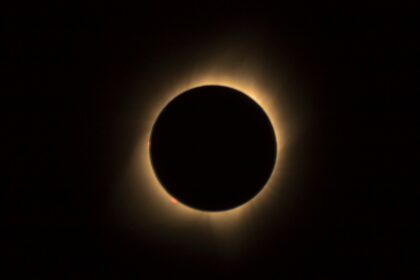
The past week brought a total solar eclipse and a magnitude 4.7 earthquake to the northeastern United States (among other places for the eclipse). For the folks who will seize any opportunity to invoke the rapture and possibly God's judgment on specific subpopulations, it was a convergence too delicious to pass up. This in turn could not be overlooked by the folks who love to trot out a science fact. Don't you know that eclipses and earthquakes have natural causes, and that the eclipse has been predictable for decades? … [Read more...] about Science Corner: So When is an Eclipse not Just an Eclipse?
science
Science Corner: Ask Your Parents Where Life Comes From
Lent is halfway through, we've set our clocks ahead, and Peeps are on the store shelves. It must be nearly spring, and so soon young men's fancies will lightly turn to thoughts of life. New life will be everywhere: blooming flowers, baby birds, buzzing cicadas. We know where this life comes from. But where did the first life come from? That remains a mystery, yet one which many young folks of all sorts seek to unravel. One group in Scotland has gone so far as to build their own "Chemputer" to help, and its first results … [Read more...] about Science Corner: Ask Your Parents Where Life Comes From
Science Corner: When the Bloom is off the Rose
Imagine if you will a holiday on which it is customary to bring flowers, chocolates, and the like to another person for whom one has romantic feelings. I know, I know, a preposterous proposition, but sometimes an outlandish thought experiment can be helpful. And so on this holiday, you bring a gift of flowers and observe how happy they make your crush. The next year, you are late to the florist and cannot get flowers so you bring chocolate instead and notice an equally happy reaction. The following year you are extra … [Read more...] about Science Corner: When the Bloom is off the Rose
Science Corner: I Wanna Live Forever … ?

Apparently, the Santa Fe Institute had a workshop on immortality last fall. There's no evidence of a theological or religious or even much of a philosophical component to the proceedings. That's maybe a little surprising, seeing as how SFI tends to be expansively interdisciplinary. But there's plenty to discuss on the scientific side of things, so fair enough. I learned about it via Sean Carroll's podcast (see below). In this special holiday episode, he shares a version of his contribution to the workshop and comments … [Read more...] about Science Corner: I Wanna Live Forever … ?
Science Corner: Deck the Halls with Balls of Agency
With Christmas less than two weeks away, I imagine many of us have babies on the brain. Apparently I did, because when I went looking for a paper to discuss, what jumped out at me was this paper on infant cognition (Preprint for those without access). It's not an especially splashy paper; it's not getting the news coverage of the latest AI developments or the claims of a theory which can reconcile gravity and quantum theory (a claim which awaits independent verification). But I suppose that's in keeping with the themes … [Read more...] about Science Corner: Deck the Halls with Balls of Agency