Archive for the ‘emerging adulthood’ tag
Emerging Adults’ View of Education
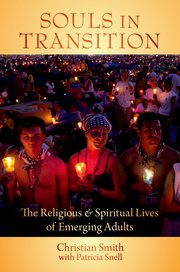
I’ve just begun reading Christian Smith’s new book (with Patricia Snell), Souls in Transition: The Religious & Spiritual Lives of Emerging Adults, and it’s already proving to be a useful resource. This is the follow-up to Smith’s last book (with Melina Denton), Soul Searching, which examined the religious lives of teenagers (ages 13 to 17). Technically, the term “emerging adults” applies to ages 18 to 29, but Souls in Transition only looks at ages 18 to 23. The rest of the “emerging adults” spectrum will be the focus of a planned third book. For an overview of Smith’s findings, check out this recent Christianity Today interview with Smith.
To set the stage for discussing religion and spirituality, Chapter 2 examines “The Cultural Worlds of Emerging Adults” – sex, relationships, morality, and so on. There’s lots of interesting stuff in this chapter – for example, Smith makes the case that emerging adults seem to be living out simplified versions of the philosophies of Jacques Derrida, Stanley Fish, Richard Rorty, and G. E. Moore – but today I’m going to highlight emerging adults’ views of education. As you might imagine, with so many either in college or aspiring to college, education forms an important part of their world view, but their view of education leans strongly to the pragmatic, instrumental value.
Many, though not all, emerging adults believe in the importance of finishing high school and getting a college education. Large numbers want to go to university, do well in school, get a degree, and put it to use. But for most, the motivating reasons behind their valuing higher education seem to have almost entirely to do with the instrumental advantages it produces — as well as the fun one can have while in college. What matters is getting the credits, earning the diploma, and becoming certified as a college-educated persona so that one can get a better job, earn more money, and become a good salary earner and supporter of a (materially) comfortable and secure life. Not very many emerging adults talk about the intrinsic value of an education, of the personal broadening and deepening of one’s understanding and appreciation of life and the world that expansive learning affords. Few talk about the value of a broad education for shaping people into informed and responsible citizens in civic life, for producing leaders and members who can work together toward the common good of all in society…For most, higher education is good instead because — besides the fun one can have while in college — it promises to help secure for individuals more rewarding jobs, higher income, and so greater personal prospects of materials and psychological well-being and security. (Smith, 54)
This attitude is not necessarily new (“Plastics,” anyone?), but elsewhere in this chapter Smith writes of emerging adults’ cultural relativism, desire for material comfort, lack of political or community engagement, and low expectations for changing the world. ESN’s mission is to see Christian scholars become redeeming influences, and InterVarsity’s Vision seeks “world changers developed,” so we are fighting against the current of the culture, according to Smith’s analysis. Since ESN encourages Christian students to pursue academic vocations, this attitude toward higher education can be a challenge to work against; important fields like the humanities can be, well, materially challenging.
Do you agree with Smith? Do emerging adults, ages 18-23, see higher education as primarily a path to middle class security? Have you seen exceptions to this? And, maybe most importantly, do Christian students mirror the culture, or are they a “counterculture for the common good”?
Week in Review: Nobel Prize Edition
Our Week-in-Review feature has a new format. We know there’s way too much to read out there already, so we’re going to be highlighting the top five articles, books, websites, etc., that we’ve been reading or thinking about the past week. If you have items you’d like us to consider for the top five, add them in the comments or send them to Tom or Mike.
Academic Nobel News – The Nobel Prizes are being handed out this week, and, as usual, academic researchers did quite well. The prize for Medicine went to Elizabeth H. Blackburn of the University of California, San Francisco; Carol W. Greider of the Johns Hopkins University School of Medicine; and Jack W. Szostak of Massachusetts General Hospital for research on telomeres. Physics was awarded to Charles Kao (who did his prize-winning work at Britain’s Standard Telephones and Cables) and Willard S. Boyle and George E. Smith of Bell Labs. Chemistry went to Venkatraman Ramakrishnan of the MRC Laboratory of Molecular Biology in Cambridge, England; Thomas A. Steitz of Yale University; and Ada E. Yonath of the Weizmann Institute of Science in Israel, for their work on the information structure of ribosomes. The two most famous Nobels – Literature and Peace – went to German poet Herta Müller and Barack Obama respectively. Economics will be awarded on Monday.
Economic Justice and the Spirit of Innovation (Edmund Phelps, First Things, October 2009) discussed by a campus group this past week.
The issue of morality in economics is neither the fairness of income distribution nor the stability of financial systems. It is how human institutions can be shaped to correspond to human nature — to man’s nature as an innovator. … Capitalism is the only economic system thus far discovered that allows human beings to realize their nature to innovate, discover, and take risks. Because human freedom is a good thing, capitalism is in this respect a good system. It is good apart from its instrumental function of presenting opportunities for income and consumption.
America Falling: Longtime Dominance in Education Erodes (Karin Fischer, Chronicle of Higher Education, October 5, 2009)
“China, Korea, Singapore—they’re going for broke because they’re hungry. They know they have to do it,” says Mr. Vest, who served on a national panel that produced a widely cited report, “Rising Above the Gathering Storm,” which warned that America was slipping behind other countries in science and technology. …
Are you hungry to learn how the world works and share that knowledge with others? What provides the basis for such a passion when competition and survival no longer inspire it?
Numbers on Nones – The excellent blog GetReligion, which covers how the mainstream covers religion, has been looking at the recent American Religious Identification Survey (ARIS). ARIS has found that the number of Americans who report “no religion” has been rising steadily and now includes 34 million Americans. ARIS calls these people “Nones,” which the atheist biologist P. Z. Myers mistakenly equates with the “godless” (his term for atheists). ARIS finds that less than 10% of Nones are truly atheists; 35% are agnostics of one sort or another, while 51% believe in some sort of god.
New Book: Souls in Transition: The Religious and Spiritual Lives of Emerging Adults by Christian Smith and Patricia Snell – Smith’s previous book, Soul Searching: The Religious and Spiritual Lives of American Teenagers
(with Melina Lundquist Denton) has greatly influenced Tom and Mike’s thinking about religious education and the role of ministries like InterVarsity. In this sociological study of American teens, sponsored by the National Study of Youth and Religion, Smith and Denton found that almost all American teens believe in a kind of “civil religion” that Smith & Denton called Moralistic Therapeutic Deism. Now, Smith and his fellow researchers have continued to follow these teens into their 20′s, the time of life that Smith identifies as “emerging adulthood,” and their findings continue to challenge long-held assumptions about religious development. For example, they found that college no longer has a corrosive effect on religious faith. In a webinar with Christianity Today (not yet available for review), Smith explicitly credited campus ministries like InterVarsity and growing numbers of evangelical professors for this striking change. Praise God! [Note: this is an important new book, so I expect we'll be reviewing it soon.]
Naomi Schaefer Riley of the WSJ has reviewed Souls in Transition, and the WSJ has also published an excerpt from Chapter One.