The Emerging Scholars Blog

From InterVarsity’s Emerging Scholars Network

Archive for the ‘ESN Book Club’ Category

Outrageous Idea 6: Building Academic Communities

with one comment

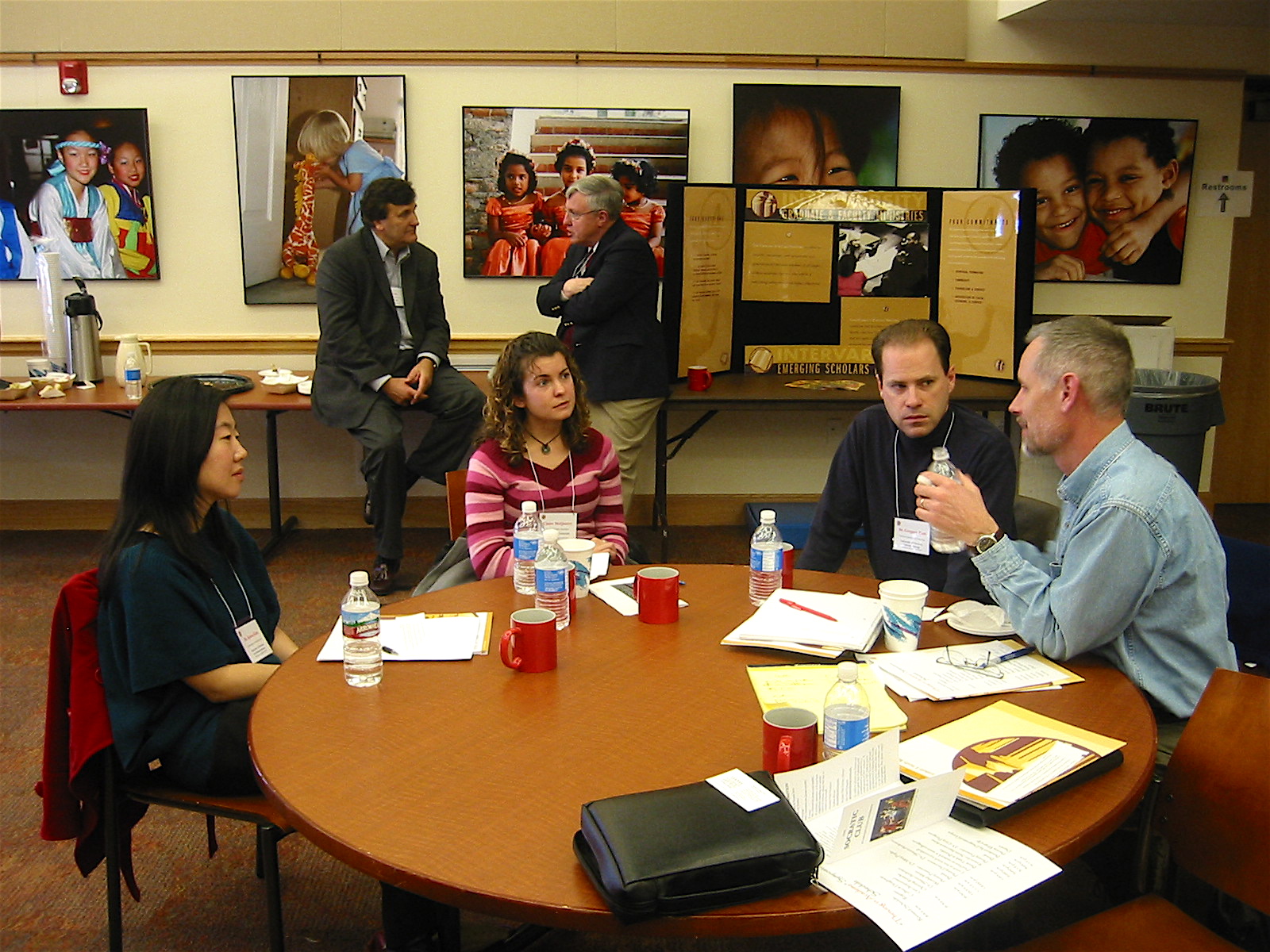
Students and Faculty at 2008 Faculty Ministry Symposium

Students and Faculty at 2008 Faculty Ministry Symposium

The final chapter in George Marsden’s The Outrageous Idea of Academic Communities Christian Scholarship [Oops! - Ed.] proposes that even the most impressive work of individual Christian scholars is not enough; Christian scholarship needs “a strong institutional base.”

Scholars, like everyone else, depend on communities. If like-minded academics do not form their own sub-communities, then they will be dependent entirely on the communities that already exist. These, of course, have little place for inquiry concerning faith and learning. If such inquiry is to grow as a recognized part of contemporary academia, it must depend on institutions and networks which can sustain that enterprise. (101)

Before getting to Marsden’s ideas, let me throw out a few discussion question: Have you experienced or witnessed successful communities of Christian scholars? What have been the outcomes? On the hand, have you seen failed or stunted attempts to build communities among Christian scholars? What went wrong?

Recognizing that, for a variety of reasons, evangelical Christians have failed to create research universities that can compete with the best secular universities, and that, to put it mildly, “the obstacles are formidable” to creating such a university, Marsden suggests some other ideas for institutional support. Some of these are already established, while others are just beginning. Marsden’s ideas are after the jump.

Read the rest of this entry »

  • Facebook
  • Google Reader
  • Twitter
  • Delicious
  • LinkedIn
  • Google Bookmarks
  • Evernote
  • WordPress
  • Share/Bookmark

Written by Micheal Hickerson

November 9th, 2009 at 11:36 am

Outrageous Idea 5: The Positive Contributions of Theological Context

without comments

Are there positive contributions to be offered by a theological context?

George Marsden responds with a hearty yes.  Why?  Because he believes (or should I say thinks, understands, or perceives):

Scholars do not operate in a vacuum, but rather within the frameworks of their communities, traditions, commitments, and beliefs.  Their scholarship, even when specialized, develops within a larger picture of reality.  So we must ask:  What is in that larger picture?  Is there a place for God?  If so does God’s presence make any difference to the rest of the picture? … (p.83).

Marsden warns the Christian scholar not “to reduce our subjects to just their theological dimensions.  (By theology here I do not mean primarily the discipline of theology, but rather any serious thought about God and God’s revelation according to a particular religious tradition)” (p.83).  According to Marsden, when Christians take “theological principles” as “just one point of reference,”

[they] can do the bulk of their academic work according to the standards and perspectives of their discipline, just as long as they are willing to keep in the mind the context of theological concerns and be open to reflecting on their implications for larger questions (p.83).

Any thoughts/reactions?

Marsden devotes the rest of the chapter to developing how “some of the most common Christian points of doctrine” speak into the assumptions and conclusions of academic disciplines:

  1. Creation
  2. The Incarnation
  3. The Holy Spirit and the Spiritual Dimensions of Reality
  4. The Human Condition

Any thoughts on how these doctrines speak into the academic world?  Any other Christian doctrines which you would desire to highlight?

Stay tuned for more on how Marsden fleshes out the application of these doctrines. …

  • Facebook
  • Google Reader
  • Twitter
  • Delicious
  • LinkedIn
  • Google Bookmarks
  • Evernote
  • WordPress
  • Share/Bookmark

Written by Tom Grosh

November 4th, 2009 at 7:00 am

Outrageous Idea 4: What difference could it possibly make?

without comments

In chapter 4 of The Outrageous Idea of Christian Scholarship, George Marsden asks, “What difference could ‘Christian scholarship’ possibly make?” He quotes a critical reviewer who wants to know whether Notre Dame teaches “Roman Catholic chemistry” or if Calvin offers “Presbyterian anthropology”. Marsden answers with two suggestions: the analogy of a gestalt image, and the setting of scholarly agendas.

Quick question: Has your scholarly agenda been shaped by your faith in Christ? Have you been drawn to particular areas of research because of your Christian commitment?

Marsden’s concrete example of the difference made by perspective is a good one, I think. He describes the way that scholarly views of the Battle of Little Big Horn have changed over time.

As long as most Americans looked at the relationships of whites to Indians only through the lens of nationalism, scholars seldom saw the Indian wars from Native American perspectives. Once moral sensitivities to the oppression of minorities became widespread, a new generation of scholars saw the same information through a new set of glasses. The evidence had not changed, but now the advance of the white settlements of America was more often understood as an “invasion.” (62-63)

As far as scholarly agendas go, Marsden cites Robert Wuthnow, who writes about “living the question”:

I have borrowed the much-used phrase “living the question” because it seems to me that Christianity does not so much supply the learned person with answers as it does raise questions. It has been said of Marxists that even apostates spend their lives struggling with the questions Marx addressed. The same can probably be said of Christianity. It leaves people with a set of questions they cannot escape, especially when these questions face them from their earliest years. (65)

Marsden spends a bit more time interacting with Wuthnow’s ideas about Christian scholarship, and grants Wuthnow’s point that “good Christian scholarship may be virtually indistinguishable from scholarship done by anyone else.” Marsden corrects an idea that “distinctively” Christian scholarship means scholarship that is “uniquely” Christian, and that there exists the Christian perspective on any academic discipline. Nonetheless, Marsden notes, it’s difficult to review the titles of Wuthnow’s books and avoid the conclusion that his Christian faith has indeed shaped his scholarship in distinctive ways.

The rest of the chapter is devoted to four specific ways in which a Christian foundation can make a clear difference in scholarship.

1. Challenging what is taken for granted: here, he provides the example of Harry Stout’s American Puritan studies, which takes the Great Awakening seriously as a “spiritual phenomenon that could not be wholly reduced to naturalistic categories,” which had become the standard academic perspective on the Puritans.

2. Challenging naturalistic reductionism: Marsden contrasts Carl Sagan’s reductionistic dictum, “The [physical] Cosmos is all that is or ever was or ever will be” with John Henry Newman’s “Christian idea of the university,” which sees academic disciplines as parts of the same interconnected truth. J. Joseph Porter has a post today at the fish tank about this very idea of Christians challenging “secular reductionism.”

3. Challenging the transcendent self: Christian scholars, with our foundation in the view that “the heart of human sinfulness is the illusion that we can be our own gods,” are distinctively able to critique academia’s celebration of the human self as an absolute good.

4. Moral judgments: “Moral judgments are not the whole of Christian influence on scholarship,” Marsden writes, but Christians have a foundation on which to base moral judgments, even if that base is often ambiguous, contradicts the judgment of fellow Christians, or seems hypocritical.

Yet all these ambiguities do not add up to an argument that Christian commitments either do not or should not make a difference in the moral agendas that so shape our scholarship. What the ambiguities suggest is that Christian commitments frequently do not make the difference that they can and should. Often part of the problem is the very kind of thing that we have been talking about, that Christians have often been too slow to challenge the conventional wisdom of their age. (81, emphasis added)

My questions for discussion (feel free to ignore them and add your own):

Do you agree with Marsden that Christian scholarship can make a difference in these four areas? Have you seen examples, in addition to Marsden’s, of Christian scholars working in these areas?

What about Robert Wuthnow’s conviction that “good Christian scholarship may be virtually indistinguishable from scholarship done by anyone else”? If this is the case, can Christians make their Christian commitment explicit without corrupting their scholarship? Should they even try?

  • Facebook
  • Google Reader
  • Twitter
  • Delicious
  • LinkedIn
  • Google Bookmarks
  • Evernote
  • WordPress
  • Share/Bookmark

Written by Micheal Hickerson

October 26th, 2009 at 9:23 pm

Outrageous Idea 3: Rules of the Game

with 2 comments

Cover of "Outrageous Idea of Christian Scholarship"

Can followers of Christ play by the rules of the academic game and still follow Christ faithfully?

According to Stanley Fish (Davidson-Kahn Distinguished University Professor and a professor of law at Florida International University, in Miami, and dean emeritus of the College of Liberal Arts and Sciences at the University of Illinois at Chicago) the answer is “No.”  Marsden summarizes Why We Can’t All Just Get Along (Stanley Fish, First Things, February 1996):

“Though secular himself, Fish cites the authority of John Milton to argue that true faith in God changes everything else.  Reason, says, Milton, following Augustine, is subject to prior faith.  That world will look very different to those who start with faith in God in contrast to faith in self or in material contingency.  It follows, Fish argues, that Christians, if they are serious about their faith, should not compromise with liberalism, which is built on antithetical principles:”

‘To put the matter baldly, a person of religious conviction should not want to enter the marketplace of ideas, but to shut it down, at least insofar as it presumes to determine matters that he believes have been determined by God and faith.  The religious person should not seek an accommodation with liberalism; he should seek to rout it from the field, to extirpate it, root and branch.’ — George Marsden.  The Outrageous Idea of Christian Scholarship.  New York:  Oxford University Press, 1997. p.44.  [Update 10/22/2009, 12:40 pm:  The second paragraph is a quote which Marsden excerpts from Stanley Fish's Why We Can't All Just Get Along (First Things, February 1996)].

How would you respond?  Read the rest of this entry »

  • Facebook
  • Google Reader
  • Twitter
  • Delicious
  • LinkedIn
  • Google Bookmarks
  • Evernote
  • WordPress
  • Share/Bookmark

Written by Tom Grosh

October 21st, 2009 at 4:47 pm

Outrageous Idea 2: Arguments for Silence

with 3 comments

Cover of "Outrageous Idea of Christian Scholarship"

Cover of "The Outrageous Idea of Christian Scholarship"

In chapter 2 of The Outrageous Idea of Christian Scholarship, George Marsden examines three “arguments for silence” common in the university for why Christians should keep their faith out of their academic work:

  • The argument of “science vs. religion”
  • The argument of multiculturalism and diversity
  • The separation of church and state

In case, Marsden summarizes the basic argument, then provides counter-arguments in favor of Christian scholars being open about their faith.

I’ll summarize chapter 2 below, but here are a few questions.

Are there other “arguments for silence” that Marsden overlooks?

Do you find Marsden’s counter-arguments convincing? How might one counter his counter-arguments?

More practically, do Marsden’s counter-arguments “work”? Have you seen Christian scholars win over opponents and open doors for the presentation of Christian scholarship?

Leave your thoughts about these questions – or about anything else related to this chapter – in the comments. My chapter 2 summary is after the jump. Read the rest of this entry »

  • Facebook
  • Google Reader
  • Twitter
  • Delicious
  • LinkedIn
  • Google Bookmarks
  • Evernote
  • WordPress
  • Share/Bookmark

Written by Micheal Hickerson

October 12th, 2009 at 11:32 am

ESN Book Club: The Outrageous Idea of Christian Scholarship

with 2 comments

The Outrageous Idea of Christian Scholarship

The Outrageous Idea of Christian Scholarship, by George Marsden

In June, we hosted our first ESN Book Club, an experiment in online book discussion and community based around John Stott’s classic, Your Mind Matters. In October, we’re going to host our 2nd ESN Book Club, this time discussing another classic, George Marsden’s The Outrageous Idea of Christian Scholarship.

In 1996, George Marsden published The Soul of the American University: From Protestant Establishment to Established Nonbelief, which traces the history of American universities from their origins as explicitly Christian institutions to their current secular condition. Marsden ended Soul with a brief “Concluding Unscientific Postscript” to put forth his concern that universities had “overcorrected” in their path toward secularism, and that religious perspectives ought to be given a greater place in the university culture. This postscript generated enough critics, questions, and conversations that Marsden felt the need to write an entire (though short) book about “the outrageous idea of Christian scholarship.” In less than 140 pages, Marsden defends the place of Christian scholarship in the secular academy and proposes a way forward for communities of Christian academics. As you might imagine, The Outrageous Idea is one of the foundational texts for the Emerging Scholars Network.

We’ll be starting to read the book together in October. I hope that you’ll join us. The book is available from Amazon in both new and used condition, and you can also find used copies on AbeBooks.com. The first 17 pages are available for your preview at Google Books. It’s likely that a Christian faculty member or InterVarsity staff on your campus has a copy, too, that they might let you borrow. And, if you’d like to host a face-to-face book club coinciding with our online discussion, a discussion guide for the book can be downloaded from the main ESN website.

  • Facebook
  • Google Reader
  • Twitter
  • Delicious
  • LinkedIn
  • Google Bookmarks
  • Evernote
  • WordPress
  • Share/Bookmark

Written by Micheal Hickerson

September 7th, 2009 at 7:00 am

Your Mind Matters 4: Acting on Our Knowledge

with one comment

Your Mind Matters

Your Mind Matters

John Stott wraps up Your Mind Matters with “Acting on Our Knowledge.”  He begins by pointing out that we avoid the swing from anti-intellectualism to hyper-intellectualism, by remembering “just one thing:  God never intends knowledge to be an end in itself but always to be means to some other end.”

As a corollary to the mind and biblical knowledge being essential to the six spheres of Christian living, see Your Mind Matters 3: The Mind in Christian Life, Stott highlights the truth that:

“the acquisition of biblical knowledge must lead into these things [i.e., the six spheres] and enrich our experience of them.  Knowledge carries with it the solemn responsibility to act on the knowledge we have, to translate our knowledge into appropriate behavior.”

As a result, we find knowledge leading to worship, faith, holiness, and love.

Knowledge is indispensable to Christian life and service.  If we do not use the mind which God has given us, we condemn ourselves to spiritual superficiality and cut ourselves off from many of the riches of God’s grace.  … What we need is not less knowledge but more knowledge, so long as we act upon it. …

How have you found knowledge leading to worship, faith, holiness, and/or love?  Do you have particular illustrations in your own life and/or those of other followers of Christ (present or past) to share with the ESN community?

To inspire you, below’s a quote from A Priest Serving in Nature’s Temple: Robert Boyle’s Career Blended Faith, Doubt, and the Use of Science to Heal Disease and Fight Atheism.

Robert Boyle (1627-91)

Robert Boyle (1627-91)

As he [Robert Boyle, 1627-91] stated in A Disquisition about the Final Causes of Natural Things, he desired “that my Reader should not barely observe the Wisdom of God, but be in some measure Affectively Convinc’d of it.” There was no better way, in Boyle’s opinion, to “give us so great a wonder and veneration for it,” than “by Knowing and Considering the Admirable Contrivance of the Particular Productions of that Immense Wisdom,” by which he mainly meant the exquisitely fashioned parts of animals both great and small. Thereby, Boyle believed, “Men may be brought, upon the same account, both to acknowledge God, to admire Him, and to thank Him.” A pious and humble man, Boyle always sought to cultivate the same attitude in others. — Ted Davis Christian History 21(4) (November 2002): 28-31.

Note:  For more visit the Robert Boyle Project and read Davis’ longer article Robert Boyle’s Religious Life, Attitudes, and Vocation Science & Christian Belief 19.2 (2007): 117-38.  If you’re interested in my notes from Davis’ 6/29/2009 lecture on Robert Boyle’s Religious Life, Attitudes, and Vocation, drop me an email.

  • Facebook
  • Google Reader
  • Twitter
  • Delicious
  • LinkedIn
  • Google Bookmarks
  • Evernote
  • WordPress
  • Share/Bookmark

Written by Tom Grosh

June 30th, 2009 at 9:13 am

Your Mind Matters 3: The Mind in Christian Life

with 4 comments

We continue our ESN Book Club discussion of John Stott’s Your Mind Matters with chapter 3, “The Mind in Christian Life.” Stott “examines six spheres of Christian living, each of which is impossible without the proper use of the mind,” namely:

  • Christian worship
  • Christian faith
  • Christian holiness
  • Christian guidance
  • Christian evangelism
  • Christian ministry

We could discuss all of these if we had time, but two items on this list which particularly struck me were holiness and guidance. Read the rest of this entry »

  • Facebook
  • Google Reader
  • Twitter
  • Delicious
  • LinkedIn
  • Google Bookmarks
  • Evernote
  • WordPress
  • Share/Bookmark

Written by Micheal Hickerson

June 23rd, 2009 at 8:00 am

Your Mind Matters 2: Why Use Our Minds?

with 2 comments

Your Mind Matters

Your Mind Matters

In the section entitled thinking God’s thoughts, John Stott argues Psalm 19:1-4 and Romans 1:18-21

refer to God’s self-revelation through the created order.  Although it is a proclamation without speech, a voice without words, yet as a result of it all men to some degree “know God.”  This assumed ability of man to read what God has written in the universe is extremely important.  All scientific research depends upon it, upon a correspondence between the character of what is being investigated and the mind of the investigator.  This correspondence is rationality. Man is able to comprehend the processes of nature.  They are not mysterious.  They are logically explicable in terms of cause and effect.  Christians believe that this common rationality between man’s mind and observable phenomena is due to the Creator who has expressed his mind in both.  As a result, in the astronomer Kepler’s famous words, men can “think God’s thoughts after him.” — Your Mind Matters, p.28

Do you agree?  Can human beings think God’s thoughts after him? Is this the basis of science and possibly even the use of the mind in general?  Is that how you approach decision making, research, teaching, and writing?

Let’s begin chatting. … In a few days I’ll throw out a couple more questions from the Chapter 2.

  • Facebook
  • Google Reader
  • Twitter
  • Delicious
  • LinkedIn
  • Google Bookmarks
  • Evernote
  • WordPress
  • Share/Bookmark

Written by Tom Grosh

June 16th, 2009 at 7:30 am

Your Mind Matters 1: Mindless Christianity

with 8 comments

Your Mind Matters

Your Mind Matters

This week starts our first ESN Book Club. Over the next four weeks, Tom and I will be leading our discussion of John Stott’s classic, Your Mind Matters. If you don’t have a copy of the book, our introduction to the ESN Book Club includes several options where you can buy it. This week, we’ll be discussing the Mark Noll’s foreword and chapter one, “Mindless Christianity,” which are available as free PDF downloads from InterVarsity Press.

Here’s how this will work: Tom and I will alternate with a post about the book each Tuesday (Thursday and Friday will be other topics as usual). The key is that we want to discuss the book, not simply review it, so we’ll highlight key passages and raise questions about the chapter, with your thoughts eagerly desired. I’m the first to admit that it won’t be as fun as a face-to-face book club, but if you want to take your laptop to your local coffee shop and sit in a comfy chair while commenting, that might help recreate the effect.

[BTW, if you are hosting a physical ESN book discussion, let us know and we'll be happy to spread the word.]

After the jump: Mark Noll’s Foreword and John Stott’s chapter on “mindless Christianity.” Read the rest of this entry »

  • Facebook
  • Google Reader
  • Twitter
  • Delicious
  • LinkedIn
  • Google Bookmarks
  • Evernote
  • WordPress
  • Share/Bookmark

Written by Micheal Hickerson

June 9th, 2009 at 7:00 am