
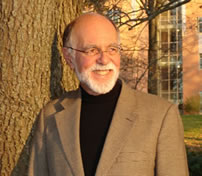
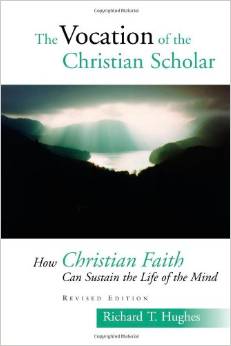
I am delighted to introduce a new series today from Dr. Richard T. Hughes, Distinguished Professor of Religion and Director of the Sider Institute for Anabaptist, Pietist, and Wesleyan Studies at Messiah College. Tom spoke with Richard at the Forgiveness Conference at Elizabethtown College this past September, and he agreed to contribute this guest series for the New Year to offer advice to students or young faculty at the beginning of their academic careers. Some of the posts in this series, including the one below, are adapted from his book, The Vocation of a Christian Scholar: How Christian Faith Can Sustain the Life of the Mind (Grand Rapids: Eerdmans, 2005).
Thank you, Dr. Hughes! ~ Mike
I have a confession to make.
I am not nearly so concerned to produce “Christian scholarship†as I am to make certain that I function as a scholar who is also a Christian, and a Christian who is also a scholar, whose scholarship is informed by my Christian commitments and whose Christian faith is enhanced by serious scholarship.
Serving as a “Christian Scholarâ€
In fact, it is not always clear to me what might qualify as “Christian scholarship.†But it is clear to me what it means to serve as a “Christian scholar.â€
Professor Paul Griffiths of the University of Chicago Divinity School [1. Now with Duke Divinity School. We highly recommend Griffiths’ essay on Christian scholarship – “From Curiosity to Studiousness: Catechizing the Appetite for Learning†– in the recent collection Teaching and Christian Practices, ed. David I. Smith and James K. A. Smith. – Ed.] once remarked that
[O]ne is a Christian scholar if one understands one’s work to be based upon and framed by and always in the service of one’s identity as a Christian.
In the same vein, Madeleine L’Engle once told a student who wished to become a “Christian writer†that
[I]f she is truly and deeply a Christian, what she writes is going to be Christian, whether she mentions Jesus or not. And if she is not, in the most profound sense, Christian, then what she writes is not going to be Christian, no matter how many times she invokes the name of the Lord.
The fundamental question implicit in both these quotes is that of vocation, for the question of vocation is finally a question of who we are, really, deep down inside—the point at which we find our deepest meaning, our deepest gladness, and our deepest joy.
And for this reason, the question of the vocation of the Christian scholar always takes precedence over the question of Christian scholarship.
The Paradox of the Christian Scholar
The question of vocation is simply this: do we have an identity that stands at the core of our being, an identity that informs every other aspect of our lives and around which every other aspect of our lives can be integrated?
But in the case of Christian scholars, the task of realizing our vocation is never easy, for those of us who are both Christians and scholars will inevitably live in the midst of a deep and inescapable paradox.
As Christians, we are committed to a highly particularistic tradition. Yet, as scholars, we are also committed to a radical search for truth that simultaneously embraces particularity and ambiguity, knowing and not knowing, affirmation and investigation.
We are called to honor our Christian faith, but we are also called to take seriously the diversity of perspectives that abound in the modern academy.
It is not our job to trump those perspectives with our Christian convictions. Instead, we are called to engage those perspectives, really engage them, and bring them into dialogue with the Christian faith.
It seems obvious, then, that if we seek to integrate every aspect of our lives around a core identity that stands at the center of our self-understanding, that core identity must itself be framed by a paradoxical vision. To make this point another way, the vocation of the Christian scholar must itself be built on paradox, simply because we cannot escape the paradox that frames our work and our calling.
The Paradox of the Gospel
The truth is, the Christian scholar can find the basis for a paradoxical self-understanding very near at hand since the notion of paradox stands at the core of the Christian message.
We find paradox, for example, in the idea of the incarnation—the infinite God of the universe who takes on the form of human flesh and who enters this world amidst cows and pigs in a lowly manger.
And paradox literally defines the gospel—we are inescapably sinners from first to last, but at the very same time, God calls us righteous, leading Luther to exclaim, simul justus et peccator!—“simultaneously justified and a sinner.â€
And the notion of paradox runs through virtually all the teachings of Jesus. We must lose ourselves to find ourselves, he says. We must die in order to live. And we can only be first by being last.
And so I close this brief reflection with a question:
How can you, the reader, tap into the Christian gospel to frame your own sense of vocation, and can you do so in ways that are faithful to the gospel, on the one hand, and faithful to your calling as a scholar, on the other?
About the author:

Richard T. Hughes has spent over 40 years working at the intersection of religion and culture in the United States. Under that broad panoply of interests, he has taught and published on (1) the biblical vision of peace and justice, (2) Christianity and America’s self-understanding, (3) the relationship between Christianity and higher education/the life of the mind, (4) the history of Christian primitivism in America, and (5) the history of Churches of Christ in America.
With a Ph.D. in the history of Christianity since 1500, Hughes has taught at Pepperdine University, Southwest Missouri State University, and Abilene Christian University. He currently serves as Distinguished Professor of Religion and Director of the Sider Institute for Anabaptist, Pietist, and Wesleyan Studies at Messiah College in Grantham, Pennsylvania.