Archive for the ‘Your Mind Matters’ tag
Must Reads for an American College Education?
Do you have a set of must reads which you believe should lie at the foundation/base of a college education (i.e., American college education), no matter the institution, e.g., Christian college/university, community college, engineering/tech school (e.g., Carnegie Mellon University or MIT), Ivy League, liberal arts college, state university? If so, what are they and why? Below’s a recent email from a faculty friend regarding his alma mater, Harvard.
it’s sad but the harvard faculty could never approve anything like the “great books” program…they could never have a coherent view of what education is about, now that the “veritas” of the old harvard has been removed…a cafeteria approach is all that could reach a consenus in the recent revision of the general education requirements…they couldn’t agree or approve the wonderful suggestion of requiring one course in “faith and reason” (broad guidelines, could even be taught by an atheist)…but too many faculty fussed and worried about any courses that involved that sloppy, unscientific thing called “faith”…St. Johns is one school that does have a “great books” program as the foundation of their liberal arts curriculum…and another school “st. thomas aquinas” (i think that’s the name) also has a similar curriculum…and the conservative “hillsdale college ” in michigan has a coherent liberal arts foundation (freshman take either greek or latin)…. [Follow-up email] … columbia university’s substantial, coherent core curriculum…harvard faculty would never approve this old-fashioned approach…consensus is impossible with them… http://www.college.columbia.edu/core
In The Paradox of Choice: Why More is Less (HarperCollins, 2005), Swarthmore Professor Barry Schwartz takes a few pages to highlight Shopping for Knowledge (pp.14-17):
1. the loss of general education requirements, in particular the capstone course which was intended to teach students how to use their college education to live a good and an ethical life, both as individuals and as members of society and 2. the purchasing of goods such as classes and degrees. … Now students are required to make choices about education that may affect them the rest of their lives. And they are forced to make these choices at a point in their intellectual development when they may lack the resources to make them intelligently.
Upon reflection, my education at Grove City College (1992-1996) began with a class to set the tone for college education but lacked a capstone course. Furthermore, the core curriculum sought to teach values over the course of several years (6 classes, 1 per term for the first three years) drawing from compilations of readings and Building a Christian Worldview (W. Andrew Hoffecker, editor, P&R Publishing, 1986. Note: written by a cross-disciplinary faculty team from the college). Although there was not a focus upon the great books providing the core of College Education, the Good Book (i.e., the Bible) was given significant attention in all the classes (Note: One of the core classes was a Bible overview).
Back to the question, do you have a set of must reads which you believe should lie at the foundation/base of a general college education (in the United States of America)?
And I guess that I have raised a second question, if must reads are not the center of a core curriculum are there certain principles at the foundation/base of a general college education (in the United States of America)? Or is a core curriculum only possible in unique educational settings and the ability to assume a college graduate has read or considered certain materials a thing of the past (or possibly one that was only fulfilled in an ideal, distant past)?
A Faith & Culture Devotional

A Faith and Culture Devotional
If you don’t already have a copy of A Faith & Culture Devotional, click here to learn how to enter a drawing for a free copy. The first drawing is on August 31st and the second on September 7th. Whether or not you win a copy, consider starting off the new term with a copy in hand.
Thank-you to Kelly Monroe Kullberg for her work on this project and the gift of this week’s devo from John Stott, see excerpt below. Note: You may remember our June study Stott’s classic Your Mind Matters.
I believe that anti‐intellectualism and fullness of the Holy Spirit are mutually incompatible. And I dare to say it because the Holy Spirit is the Spirit of Truth. Jesus our Lord himself referred to the Holy Spirit as the Spirit of Truth, and therefore, it is only logical to say that wherever the Holy Spirit has given his freedom, truth is bound to matter. So I have argued, and argue still, that a proper, conscientious use of our minds is an inevitable part and parcel of our Christian life. …
Is there a Christian intellectual presence on your campus?

One form of Christian presence on campus.
A few different strands of thought came together for me this morning in the form of a question. Let me throw out the question first, and then elaborate.
Is there a public Christian intellectual presence on your campus?
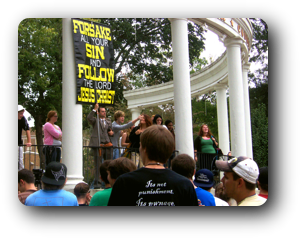
Here are the threads that came together for me. First, in our recent book discussion of John Stott’s Your Mind Matters, Stott describes a kind of intellectualism that is very public. For example, in chapter 3, he “examines six spheres of Christian living, each of which is impossible without the proper use of the mind”: worship, faith, holiness, guidance, evangelism, and ministry. These have internal and private aspects, but also external, public aspects. I’d be willing to bet that, on your campus, there are at least two or three of these which are very public indeed. Picture the sidewalk evangelists who roam through each year, or campus ministry student outreach events. On some campuses, worship or holiness might have similar public aspects.
Image credit: falonyates via Flickr.
Your Mind Matters 4: Acting on Our Knowledge

Your Mind Matters
John Stott wraps up Your Mind Matters with “Acting on Our Knowledge.” He begins by pointing out that we avoid the swing from anti-intellectualism to hyper-intellectualism, by remembering “just one thing: God never intends knowledge to be an end in itself but always to be means to some other end.”
As a corollary to the mind and biblical knowledge being essential to the six spheres of Christian living, see Your Mind Matters 3: The Mind in Christian Life, Stott highlights the truth that:
“the acquisition of biblical knowledge must lead into these things [i.e., the six spheres] and enrich our experience of them. Knowledge carries with it the solemn responsibility to act on the knowledge we have, to translate our knowledge into appropriate behavior.”
As a result, we find knowledge leading to worship, faith, holiness, and love.
Knowledge is indispensable to Christian life and service. If we do not use the mind which God has given us, we condemn ourselves to spiritual superficiality and cut ourselves off from many of the riches of God’s grace. … What we need is not less knowledge but more knowledge, so long as we act upon it. …
How have you found knowledge leading to worship, faith, holiness, and/or love? Do you have particular illustrations in your own life and/or those of other followers of Christ (present or past) to share with the ESN community?
To inspire you, below’s a quote from A Priest Serving in Nature’s Temple: Robert Boyle’s Career Blended Faith, Doubt, and the Use of Science to Heal Disease and Fight Atheism.
As he [Robert Boyle, 1627-91] stated in A Disquisition about the Final Causes of Natural Things, he desired “that my Reader should not barely observe the Wisdom of God, but be in some measure Affectively Convinc’d of it.” There was no better way, in Boyle’s opinion, to “give us so great a wonder and veneration for it,” than “by Knowing and Considering the Admirable Contrivance of the Particular Productions of that Immense Wisdom,” by which he mainly meant the exquisitely fashioned parts of animals both great and small. Thereby, Boyle believed, “Men may be brought, upon the same account, both to acknowledge God, to admire Him, and to thank Him.” A pious and humble man, Boyle always sought to cultivate the same attitude in others. — Ted Davis Christian History 21(4) (November 2002): 28-31.
Note: For more visit the Robert Boyle Project and read Davis’ longer article Robert Boyle’s Religious Life, Attitudes, and Vocation Science & Christian Belief 19.2 (2007): 117-38. If you’re interested in my notes from Davis’ 6/29/2009 lecture on Robert Boyle’s Religious Life, Attitudes, and Vocation, drop me an email.
Your Mind Matters 3: The Mind in Christian Life
We continue our ESN Book Club discussion of John Stott’s Your Mind Matters with chapter 3, “The Mind in Christian Life.” Stott “examines six spheres of Christian living, each of which is impossible without the proper use of the mind,” namely:
- Christian worship
- Christian faith
- Christian holiness
- Christian guidance
- Christian evangelism
- Christian ministry
We could discuss all of these if we had time, but two items on this list which particularly struck me were holiness and guidance. Read the rest of this entry »
Your Mind Matters 2: Why Use Our Minds?

Your Mind Matters
In the section entitled thinking God’s thoughts, John Stott argues Psalm 19:1-4 and Romans 1:18-21
refer to God’s self-revelation through the created order. Although it is a proclamation without speech, a voice without words, yet as a result of it all men to some degree “know God.” This assumed ability of man to read what God has written in the universe is extremely important. All scientific research depends upon it, upon a correspondence between the character of what is being investigated and the mind of the investigator. This correspondence is rationality. Man is able to comprehend the processes of nature. They are not mysterious. They are logically explicable in terms of cause and effect. Christians believe that this common rationality between man’s mind and observable phenomena is due to the Creator who has expressed his mind in both. As a result, in the astronomer Kepler’s famous words, men can “think God’s thoughts after him.” — Your Mind Matters, p.28
Do you agree? Can human beings think God’s thoughts after him? Is this the basis of science and possibly even the use of the mind in general? Is that how you approach decision making, research, teaching, and writing?
Let’s begin chatting. … In a few days I’ll throw out a couple more questions from the Chapter 2.
Your Mind Matters 1: Mindless Christianity

Your Mind Matters
This week starts our first ESN Book Club. Over the next four weeks, Tom and I will be leading our discussion of John Stott’s classic, Your Mind Matters. If you don’t have a copy of the book, our introduction to the ESN Book Club includes several options where you can buy it. This week, we’ll be discussing the Mark Noll’s foreword and chapter one, “Mindless Christianity,” which are available as free PDF downloads from InterVarsity Press.
Here’s how this will work: Tom and I will alternate with a post about the book each Tuesday (Thursday and Friday will be other topics as usual). The key is that we want to discuss the book, not simply review it, so we’ll highlight key passages and raise questions about the chapter, with your thoughts eagerly desired. I’m the first to admit that it won’t be as fun as a face-to-face book club, but if you want to take your laptop to your local coffee shop and sit in a comfy chair while commenting, that might help recreate the effect.
[BTW, if you are hosting a physical ESN book discussion, let us know and we'll be happy to spread the word.]
After the jump: Mark Noll’s Foreword and John Stott’s chapter on “mindless Christianity.” Read the rest of this entry »
Who is in your class?
Would you agree with my idealistic enthusiasm for My Freshman Year: What a Professor Learned by Becoming a Student, the story of a professor of anthropology at a large state university who realized that she no longer understood the behavior and attitudes of her students and returned to the classroom? And my uneasiness when reading that some Online Professors Pose as Students to Encourage Real Learning (Chronicle of Higher Education, 5/29/09), in the class which they’re teaching? Can you offer testimonies, tips, or sources regarding what it takes to stimulate an on-line learning community? We would love to have specific suggestions regarding how to direct the conversation of the ESN Book Club: Your Mind Matters.
Note: If you don’t have a copy of John Stott’s Your Mind Matters, I’d encourage you to borrow/purchase so you’re ready to go on Tuesday. If you’d like a head start on reading but don’t have a copy of the book, visit InterVarsity Press’ website for PDFs of the Foreward and Chapter 1.