Archive for the ‘links’ tag
Week in Review
This is our weekly post of links, resources, and articles that would be helpful to ESN members. If you’d like to contribute something, please suggest it in the comments, or send it directly to either Tom or Mike.
Update on the ESN Book Club: We’ve moved the dates back for our discussions to give you more time to order and start reading John Stott’s Your Mind Matters. The discussions will now start June 9. Read all the details here.
From Tom
Psychology Grad Students Get Counseled on How to Teach: Below are a few suggestions, do they apply to all fields? Are there key truths missing? Read the rest of this entry »
Week in Review
[Editor's note: This is a new weekly feature from your blog contributors. Each week, we'll be posting articles, books, news, etc., that Tom, Mike, and the ESN community have been pondering. If you have a book or article you'd like us to add to next week's Review, add it in the comments or send it to either Mike or Tom. Thanks!]
After Accepting Students, NYU Asks Them: Are We Too Costly for You? (Chronicle of Higher Education, $) – NYU is asking admitted students to consider whether they can truly afford to attend.
Not Moving On Up – The MLA’s new report (Standing Still) finds that women are promoted to full professor at a slower rate than men, and that pregnancy and childrearing may not have much to do with the trend.
Following Christ 2008 track audios: Lots of good material! Join Tom in digging in, discussing, and passing along to those with interest.
Pastor and Scholar: John Piper and D.A. Carson recently spoke together on the topics “The Pastor as Scholar” (Piper) and “The Scholar as Pastor” (Carson) at an event sponsored by TEDS. They mostly focused on theological/seminary scholarship, but lots of good stuff about vocation, the integration of faith, life, and learning, and personal experiences. Audio, video, and manuscripts are available for download.
Do you need a PhD to teach in higher education? Rob Jenkins doesn’t think so.
Tech Stuff
Amazon releases the Kindle DX with a large screen, built-in PDF reader, and deals in place to offer electronic textbooks. Case Western Reserve U. will be studying how the ebook experience compares to traditional textbooks. Here’s Jeffrey Young’s take on the idea at the Chronicle.
Omeka – A new open-source project for online archives, scholarly websites, and other “complex narratives.” (HT: Dan Cohen)
Free Amazon Web Services for Academics – Mike has no idea what this actually means, but he’s sure it will be useful to someone. (HT: MacWorld)
Books
Your Mind Matters by John Stott. In June, we’re going to begin an on-line discussion series of this 93 page classic introduction to Christian thinking. In order to be prepared, Tom once again picked up his heavily notated edition. If you don’t already have a copy of Your Mind Matters, borrow one from your InterVarsity staff or order one with your Emerging Scholars Network discount for InterVarsity Press. More details tba ;-)
Made to Stick: Why Some Ideas Survive & Others Die by Chip & Dan Heath (HT: Mike). In the first chapter, Tom’s most impressed with Commander’s Intent, what he summarizes as the compact, core idea which guides good decision making in the field as one’s best laid plans unwind in the midst of the daily grind. Love this quote, “No plan survives contact with the enemy. No doubt this principle has resonance for people who have no military experience whatsoever. No sales plan survives contact with the customer. No lesson plan survives contact with teenagers” (p.27, italics in original text).
Reaching the Campus Tribes by Benson Hines is a free on-line book exploring campus ministry in the USA (HT: The IVY Jungle Network Campus Ministry April 2009 Update). Tom encourages you to take the time to download, skim, enjoy the pics, and share your thoughts. He’s posted some initial reflections here and more here.
Keeping “to-do lists”
Are to-do lists a helpful tool to getting things done? Or do you find them frustratingly long and seemingly insurmountable? Or do you find them buried under papers or in old documents/post-it notes on your screen, wall, door? Or do you somehow ignore to-do lists entirely?
Thanks to Andy Crouch’s 5 Questions post on to-do lists, I’ve had quite a few good conversations with friends and family on this topic. Two pastors of my local congregation have given some interesting feedback on the topic. One quipped that he finds to-do lists helpful in his search for significance, i.e., when he crosses items off his list he feels like he’s accomplished something. He confesses to sometimes adding items to be crossed off … I’ve heard this from some other people ;-) Another pastor noted the cultural rootedness of to-do lists:
In our culture, almost everyone has multiple things to manage, most not by choice but by necessity in our complex, multi-faceted world – more than can conveniently be remembered. Thus the need for external support mechanisms.
What are you thoughts? In what manner are to-do lists vital to the scholar. Does this vary from field to field and the level of one’s responsibility? What tools do you use to manage and prioritize items on to-do lists? Is this cultural artifact unique and/or over-used in the United States (or Western Civilization)?
Maybe this should be the topic for Chapter 2 of Up to the Minute Publishing ;-)
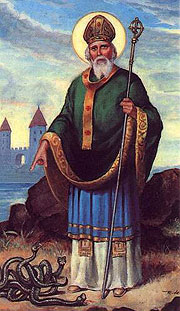
Celebrating St. Patrick’s Day
Take a moment sometime today to consider The Real St. Patrick and invite others to do likewise. Looking for some resources? I’d encourage you to start with The Real St. Patrick and St. Patrick’s Day. If you have additional suggestions, including books to recommend, please share below.

St. Patrick
Christ with me, Christ before me, Christ behind me,
Christ in me, Christ beneath me, Christ above me,
Christ on my right, Christ on my left,
Christ when I lie down, Christ when I sit down,
Christ in the heart of every man who thinks of me,
Christ in the mouth of every man who speaks of me,
Christ in the eye that sees me,
Christ in the ear that hears me.
I arise today
Through a mighty strength, the invocation of the Trinity,
Through a belief in the Threeness,
Through a confession of the Oneness
Of the Creator of creation.
– A Poem by St. Patrick, ca 377 AD
Dennett and Plantinga at APA
Longtime friend of ESN Jay Woodham shared this link on Facebook to an “opinionated play-by-play” of the dialogue between Christian philosopher Alvin Plantinga and atheist philosopher Daniel Dennett at the recent American Philosophical Association meeting. It’s a very interesting read, both the blog post and the comments, about a discussion between two of the leading philosophers in academia today. The contributor admits his bias towards Plantinga, so read it for what it’s worth, though some of his judgments are countered by commenters. The bloggers does a good job, in my opinion, of putting Plantinga and Dennett in philosophical context for those of us (like myself) who are only familiar with them through the current debates about atheism and naturalism.
Also in the comments is a side conversation about whether or not open belief in God is a hazard to one’s career in philosophy. The commenters are split: some say that it’s not a problem at all, while others strongly recommend keeping your theism under your hat. (My bet is that it strongly depends on your particular department and the attitudes of its faculty.)
BTW, if you are interested in Plantinga, his book Warranted Christian Belief is available for free from the always excellent Christian Classics Ethereal Library.
Following Christ 08 resources coming on-line
On InterVarsity’s main website, one can find two articles
AND two audio files
- Why Aren’t We Flourishing? — Opening Plenary by MaryKate Morse, Professor of Leadership and Spiritual Formation at George Fox University. Time: 35:00
- Powerful Faith — Seminar presentation by Michael Lindsay, a sociologist at Rice University and the author of Faith in the Halls of Power. The seminar in which Michael Lindsay spoke was entitled Exploring Privilege and Redeeming Power. Time: 1:15:09
After you’ve reflected upon the presentations, take a moment to share some thoughts on fear, power, and faith in higher education.
Happy Birthday, John!
Today is John Milton’s 400th birthday – or, rather, would have been. If you choose to celebrate this occasion, you can visit the John Milton Reading Room at Dartmouth, which contains ALL of Milton’s poetry (in English, Italian, Latin, and Greek) and selections from his prose, along with annotations.
(HT: The Wired Campus)
Warranted Christian Belief and CCEL
The Christian Classics Ethereal Library is an incredible resource for theological and devotional classics. It specializes in free or low-cost public domain books. For example, don’t have $300 to plunk down for an entire edition of the Ante-Nicene, Nicene, and Post-Nicene Fathers? Download them from CCEL.
Today, I received notice that CCEL has obtained permission to publish Alvin Plantinga’s Warranted Christian Belief (Oxford, 2000). Here’s CCEL’s description of this highly regarded book:
Warranted Christian Belief is a philosophical defense of the reasonableness of belief in God and the great matters of the faith. It answers all the common objections how could a good God allow so much evil in the world? Isn’t belief in God is irrational because there isn’t enough evidence, or because it is only wish fulfillment? Doesn’t modern theology show that the traditional beliefs are false? How about postmodernism? You get the idea. These objections are answered in a way that is philosophically rigorous. The treatment is perhaps at a level appropriate for a college philosophy student rather than other professional philosophers.
Here is the full announcement. You can read the book online or download a plain text version for free, or download a PDF for $2.95.
New Technology and Academic Research
A few links to pass along, regarding connections between new technology and academic research.
- The Chronicle’s Wired Campus blog last week reported on academic uses for Google Earth, such as a map of county-by-county election results, dating back to 1840.
- Alice Marwick has posted an annotated bibliography of academic research on LiveJournal. (HT: danah boyd, who has also compiled a bibliography on social network research)
Online social networks are one of my (many) casual interests. Any other links on this topic that I should know about?
New Podcast Series from Christianity Today
Christianity Today has launched a new podcasting series featuring “editorials, news and books commentaries” (iTunes link). I just subscribed, and noticed that it looks like ESN partner Books & Culture will be featured regularly. There are already two podcasts with B&C editor John Wilson, discussing recent books by Rodney Stark and Christopher Buckley.
Personally, I enjoy listening to John Piper’s sermon podcasts and Mars Hill Audio’s Audition, as well as my guilty pleasure, ESPN’s BS Report with Bill Simmons. What are some of your favorite podcasts?

