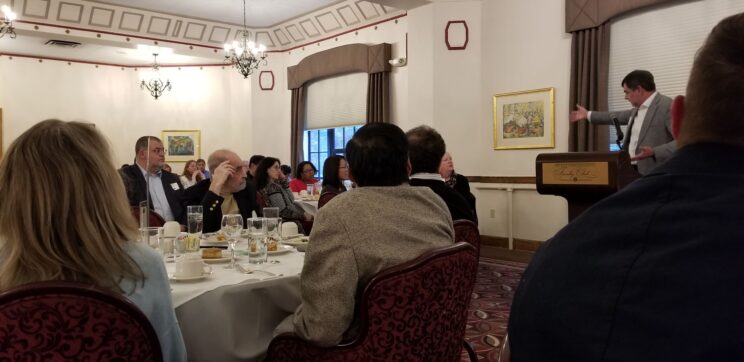
Imagine faculty on your university gathering across disciplinary and religious lines to discuss important questions common to the human experience. On March 22, over a hundred faculty and other guests gathered to do just that over dinner at the Ohio State University’s Faculty Club, preceded by a reception.
University Provost Karla Zadnik opened the evening with a warm welcome expressing interest in the topic of suffering and learning from one another how we engage this common human experience. Our main speaker for the evening was Dr. Curt Thompson, author of the recently published The Deepest Place. Thompson spoke about material covered in the book, particularly his work with patients who have suffered trauma or suffer in other ways. He discussed the importance of secure attachments with others to help “rewire” our responses to suffering, including “confessional communities” of others who suffer. He referenced Romans 5:1-5 which speaks of a sequence of suffering, perseverance, character, and hope. And he pointed to how, for him as a Christian, being justified through faith and loved by God was the ultimate secure attachment.
Two other university faculty also responded. Dr. Asma Mobin-Uddin, who holds appointments in Pediatrics and with the Center for Bioethics at Ohio State, shared a Muslim perspective on suffering as God’s refining process. She also remarked at how she was pleased to find a setting where she didn’t need to mute her religious convictions. Finally, Dr. Paul Granello, a cognitive psychologist who works in the area of suicide prevention spoke on the importance of hope for those contemplating suicide and how this hope is a cognitive process, rather than an emotion, and that people could learn to be hopeful and exercise agency in their situations.
This was followed by 20 minutes for table discussions and then a similar period for questions for the speakers. A list of discussion starters were provided at each table and table discussions were animated. Participants were invited to share their feedback on the event. Here are two comments that were representative:
“This kind of space is a special and significant gathering to nurture and curate–particularly in American society today.”
“I really enjoyed the presentations and the conversation at my table. We had a stage 3 colon cancer survivor, a MD and a med student just beginning residency, so we had a rich conversation about suffering and how hope might be a cognitive process.”
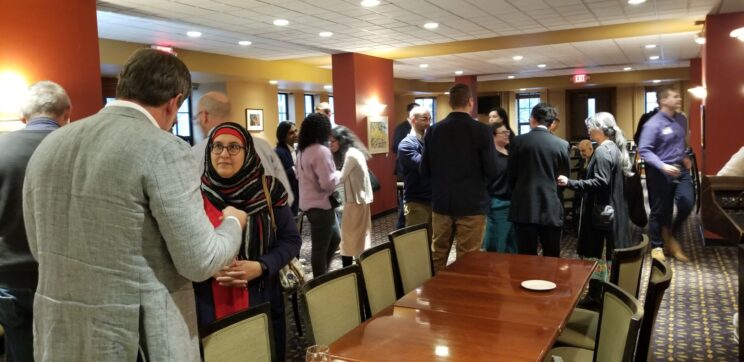
Kathy McCready, an InterVarsity GFM staff in Pittsburgh visited the event and shared this comment:
“There was a warm collegial atmosphere, beginning at the reception before dinner and continued throughout the evening. Wherever I looked during the reception, people were in conversation. The Faculty Roundtable event modeled and brought together the best of what it means to be in the university setting. Diverse ideas can be shared and respectfully discussed, even if you disagree. I wish this could be modeled in more places in our American society.”
Howard Van Cleave, one of the event organizers related a couple other stories from the evening:
“One elderly Jewish man who is going through depression came and sat next to a Jewish-Christian pastor, and they connected very well. Another couple came to the room by mistake, intending to go to a different meeting. When they read the flier, they ended up staying at the round table (there were a few open spots due to no-shows). “
While the full impact of the evening is known only to God, event organizers offered opportunities for participants to participate in follow-on discussions as well.
The Emerging Scholars Network was a sponsor of this event and we are very excited to see this kind of public engagement of Christians around important topics in the middle of the university. We would love to hear about and share reports of similar events at other campuses.