
A few different strands of thought came together for me this morning in the form of a question. Let me throw out the question first, and then elaborate.
Is there a public Christian intellectual presence on your campus?
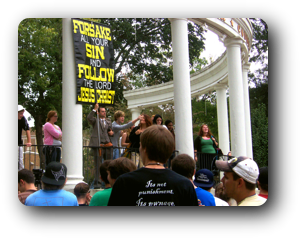
Here are the threads that came together for me. First, in our recent book discussion of John Stott’s Your Mind Matters, Stott describes a kind of intellectualism that is very public. For example, in chapter 3, he “examines six spheres of Christian living, each of which is impossible without the proper use of the mind”: worship, faith, holiness, guidance, evangelism, and ministry. These have internal and private aspects, but also external, public aspects. I’d be willing to bet that, on your campus, there are at least two or three of these which are very public indeed. Picture the sidewalk evangelists who roam through each year, or campus ministry student outreach events. On some campuses, worship or holiness might have similar public aspects.
Image credit: falonyates via Flickr.
Second, John Sommerville’s call at this year’s Midwest Faculty Conference for Christians to make new culture in the university. In one respect, this will require Christians who are public intellectuals, on their campus if not in the broader community. I think of academics like Jacques Ellul, Henri Nouwen, or (to mention someone still alive!) Mary Poplin, who build explicit connections between theology and their academic disciplines. There are many more people – and models for doing this – that could be mentioned. (Francis Collins, of course, is another.)
Finally, while at the Midwest Faculty Conference, I spoke with John Sommerville briefly about his involvement with the Christian Study Center at U. Florida, which is one of a number of Christian Study Centers around the country. (Others include the MacLaurin Institute in Minneapolis, the Rivendell Institute at Yale, Chesterton House at Cornell, and the Center for Christian Study in Virginia.) John commented that the campus ministries at UF didn’t have much involvement with the Center as he would like, and we wondered together if campus ministries (in general) understood the importance of a Christian presence among the ideas of the university.
So, after all that, back to my question: Is there a public Christian intellectual presence on your campus? If you’re wondering about the many modifiers in that question, here are some ad hoc definitions:
- Public: Involved in the common life of the university. Not necessarily outspoken or famous, but known on the campus in general, not just within a small group of insiders.
- Christian: Explicitly Christian in their beliefs and thought. Not necessarily trying to bring up their faith at every opportunity, but also not attempting to hide it or keep a clean separation between their public and private personas.
- Intellectual: Characterized by the life of the mind, careful and considered thoughtfulness, and good scholarship. Ideally, respected by both friends and foes as a solid thinker.
- Presence: A recognizable part of the broader campus community and culture (and not just the Christian communities).
(Feel free to dispute or redefine any of these definitions in the comments.)
And, if your campus has a public Christian intellectual presence, what does it look like?
About the author:

The former Associate Director for the Emerging Scholars Network, Micheal lives in Cincinnati with his wife and three children and works as a web manager for a national storage and organization company. He writes about work, vocation, and finding meaning in what you do at No Small Actors.