
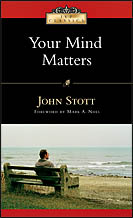
John Stott wraps up Your Mind Matters with “Acting on Our Knowledge.â€Â He begins by pointing out that we avoid the swing from anti-intellectualism to hyper-intellectualism, by remembering “just one thing: God never intends knowledge to be an end in itself but always to be means to some other end.”
As a corollary to the mind and biblical knowledge being essential to the six spheres of Christian living, see Your Mind Matters 3: The Mind in Christian Life, Stott highlights the truth that:
“the acquisition of biblical knowledge must lead into these things [i.e., the six spheres] and enrich our experience of them. Knowledge carries with it the solemn responsibility to act on the knowledge we have, to translate our knowledge into appropriate behavior.”
As a result, we find knowledge leading to worship, faith, holiness, and love.
Knowledge is indispensable to Christian life and service. If we do not use the mind which God has given us, we condemn ourselves to spiritual superficiality and cut ourselves off from many of the riches of God’s grace. … What we need is not less knowledge but more knowledge, so long as we act upon it. …
How have you found knowledge leading to worship, faith, holiness, and/or love? Do you have particular illustrations in your own life and/or those of other followers of Christ (present or past) to share with the ESN community?
To inspire you, below’s a quote from A Priest Serving in Nature’s Temple: Robert Boyle’s Career Blended Faith, Doubt, and the Use of Science to Heal Disease and Fight Atheism.

As he [Robert Boyle, 1627-91] stated in A Disquisition about the Final Causes of Natural Things, he desired “that my Reader should not barely observe the Wisdom of God, but be in some measure Affectively Convinc’d of it.” There was no better way, in Boyle’s opinion, to “give us so great a wonder and veneration for it,” than “by Knowing and Considering the Admirable Contrivance of the Particular Productions of that Immense Wisdom,” by which he mainly meant the exquisitely fashioned parts of animals both great and small. Thereby, Boyle believed, “Men may be brought, upon the same account, both to acknowledge God, to admire Him, and to thank Him.” A pious and humble man, Boyle always sought to cultivate the same attitude in others. — Ted Davis Christian History 21(4) (November 2002): 28-31.
Note: For more visit the Robert Boyle Project and read Davis’ longer article Robert Boyle’s Religious Life, Attitudes, and Vocation Science & Christian Belief 19.2 (2007): 117-38. If you’re interested in my notes from Davis’ 6/29/2009 lecture on Robert Boyle’s Religious Life, Attitudes, and Vocation, drop me an email.
About the author:

Tom enjoys daily conversations regarding living out the Biblical Story with his wife Theresa and their four girls, around the block, at Elizabethtown Brethren in Christ Church (where he teaches adult electives and co-leads a small group), among healthcare professionals as the Northeast Regional Director for the Christian Medical & Dental Associations (CMDA), and in higher ed as a volunteer with the Emerging Scholars Network (ESN). For a number of years, the Christian Medical Society / CMDA at Penn State College of Medicine was the hub of his ministry with CMDA. Note: Tom served with InterVarsity Christian Fellowship / USA for 20+ years, including 6+ years as the Associate Director of ESN. He has written for the ESN blog from its launch in August 2008. He has studied Biology (B.S.), Higher Education (M.A.), Spiritual Direction (Certificate), Spiritual Formation (M.A.R.), Ministry to Emerging Generations (D.Min.). To God be the glory!