
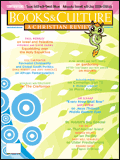
In the March/April edition of Books & Culture:Â A Christian Review, Nicholas Wolterstorff’s review of Richard Sennett’s The Craftsman (Yale University Press, 2008) raises concerns of particular relevance to Emerging Scholars.
First, Wolterstorff digs into Sennett’s critique of the lower status given to animal laborans (i.e., the laboring human being, who asks How?) in relationship to homo faber (i.e., the human being who asks Why? and assumes the role of guide/critic to animal laborans). Some quotes from The Craftsman which particularly resonate with Wolterstorff include:
Thinking and feeling are contained within the process of making. … Western civilization has had a deep-rooted trouble in making connections between head and hand, in recognizing and encouraging the impulse of craftsmanship. — from Thinking with Your Hands, by Nicholas Wolterstorff, Books & Culture:Â A Christian Review, March/April 2009, p.30.
After sharing his own cabinetmaking/craftsman heritage, Wolterstorff points out the pecking order found in higher education (personally experienced by him not only at Yale, but also Calvin College):
If you use your hands or teach those who use their hands — “hands” being used both literally and metaphorically here — you are inferior to those who use only their heads: practicing musicians are inferior to musicologists, painters are inferior to art historians, teachers of business are inferior to economists, teachers of preaching are inferior to theologians. The basic attitude was stated crisply by Aristotle at the opening of Metaphysics: “We think the master-workers in each craft are more honourable and know in a truer sense and are wiser than the manual workers” — from Thinking with Your Hands, by Nicholas Wolterstorff, Books & Culture: A Christian Review, March/April 2009, p.30.
More from the review to come. … But first, let’s consider the relationship between animal laborans andhomo faber. Do you agree with the dichotomy? Is it helpful? Is there a proper and improper use of the distinction? Does it exist on your campus, in your discipline? How do you interact with it as one who follows The Craftsman, One who not only shaped wood as the son of a carpenter, but all of the creation in the beginning (and continues to do such in some manner)?
*Note:Â If you are not already a subscriber to Books & Culture:Â A Christian Review, click here for information on the great deal for members of the Emerging Scholars Network.
About the author:

Tom enjoys daily conversations regarding living out the Biblical Story with his wife Theresa and their four girls, around the block, at Elizabethtown Brethren in Christ Church (where he teaches adult electives and co-leads a small group), among healthcare professionals as the Northeast Regional Director for the Christian Medical & Dental Associations (CMDA), and in higher ed as a volunteer with the Emerging Scholars Network (ESN). For a number of years, the Christian Medical Society / CMDA at Penn State College of Medicine was the hub of his ministry with CMDA. Note: Tom served with InterVarsity Christian Fellowship / USA for 20+ years, including 6+ years as the Associate Director of ESN. He has written for the ESN blog from its launch in August 2008. He has studied Biology (B.S.), Higher Education (M.A.), Spiritual Direction (Certificate), Spiritual Formation (M.A.R.), Ministry to Emerging Generations (D.Min.). To God be the glory!